



What's Happening?
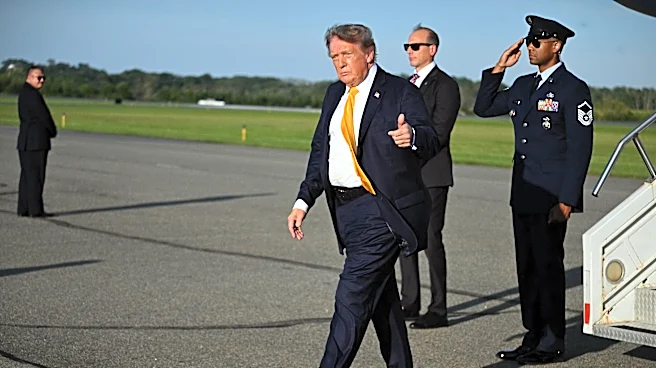
President Trump has repeatedly asserted that 'most people don't know' that the word 'dumb' ends with the letter 'B.' He has made this claim on multiple occasions, including at the White House, during a White House Correspondents' Dinner, and in interviews.
This assertion is part of his effort to brand Democrats as 'Dumocrats' by changing the 'E' to a 'U' in 'Democrat' and then linking it to the word 'dumb.' He explains that since 'most people don't know' about the silent 'B' in 'dumb,' the one-letter change to 'Dumocrat' is a clever play on words. Critics suggest that this narrative is a way for President Trump to justify his preferred spelling of the insult, rather than admitting it might not be his most effective nickname. The core of the issue is his insistence that a common four-letter word, typically learned in grade school, is widely misspelled or misunderstood by the public.
Why It's Important?
President Trump's repeated emphasis on the spelling of 'dumb' and his claim that 'most people don't know' about the silent 'B' is important because it reflects a broader communication strategy that often involves creating and reinforcing specific narratives, even when they appear to contradict common knowledge. This approach can influence public discourse by shifting focus to seemingly trivial details, potentially distracting from more substantive policy discussions. By asserting a widespread ignorance about a simple word, President Trump attempts to position himself as uniquely insightful or to frame the public as less informed, which can serve to bolster his own image or discredit opponents. This communication style can also contribute to a climate where factual accuracy is debated, even on basic matters, impacting how information is consumed and evaluated by the public. The use of such linguistic tactics in political rhetoric can shape perceptions of intelligence, education, and credibility, affecting how voters engage with political figures and their messages. It highlights the power of language and narrative in contemporary politics, where even minor linguistic points can become part of a larger political strategy.
What's Next?
It is likely that President Trump will continue to use the 'Dumocrat' moniker and the accompanying explanation about the spelling of 'dumb' in his political rhetoric, especially as he continues to engage in public discourse. This communication tactic, having been repeated over several months, appears to be a consistent element of his strategy to criticize political opponents. The ongoing use of such language will likely continue to draw reactions from both supporters, who may find it amusing or effective, and critics, who may view it as trivializing or misleading. The broader implications for political communication suggest that such seemingly minor linguistic points can become ingrained in political narratives, influencing how political figures are perceived and how political debates are framed. This could lead to further discussions about the role of language, accuracy, and perceived intelligence in political campaigns and public statements.
Beyond the Headlines
President Trump's 'dumb' spelling story, while seemingly trivial, touches upon deeper aspects of public perception, education, and the nature of political discourse. The assertion that 'most people don't know' about the silent 'B' in 'dumb' can be seen as a subtle challenge to collective intelligence and educational standards. It raises questions about how readily the public accepts or questions such claims, and the role of media in fact-checking seemingly minor linguistic points. Ethically, the deliberate propagation of a potentially misleading narrative, even about a word's spelling, can contribute to a broader environment of misinformation, where the line between fact and opinion becomes blurred. Culturally, it reflects a political style that often prioritizes rhetorical impact over strict factual adherence, a trend that has significant implications for civic literacy and critical thinking. The long-term shift could be towards a political landscape where the perceived 'truth' is more influenced by persuasive narratives than by verifiable facts, challenging traditional notions of informed public debate.