



What's Happening?
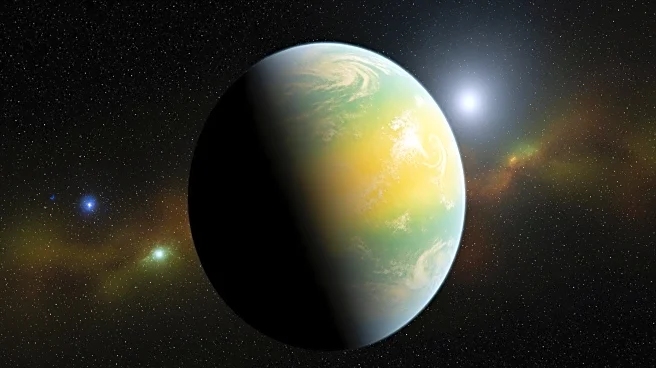
The James Webb Space Telescope (JWST) has discovered an exoplanet, PSR J2322-2650b, with a highly unusual ellipsoid shape and an atmosphere unlike any previously observed. This planet, which orbits a pulsar, has a mass similar to Jupiter and is located
approximately 1 million miles from its parent star. The pulsar's gravitational forces have shaped the planet into a lemon-like form. The atmosphere of PSR J2322-2650b is dominated by helium and carbon, with clouds of carbon soot that may condense into diamond rain. This discovery challenges existing theories of planet formation, as the planet's atmosphere lacks typical molecules like water and methane, instead featuring molecular carbon. The JWST's infrared capabilities allowed scientists to study this unique atmosphere in detail, revealing a composition that defies known formation mechanisms.
Why It's Important?
This discovery is significant as it challenges current understanding of planetary formation and atmospheric composition. The presence of molecular carbon in the atmosphere of PSR J2322-2650b, without the usual oxygen or nitrogen, suggests a formation process that is not yet understood. This could lead to new insights into the diversity of planetary systems and the role of pulsars in shaping planetary bodies. The findings may also have implications for the study of dark matter and the gravitational effects it can have on celestial bodies. As the JWST continues to explore the universe, it may uncover more such anomalies, prompting a reevaluation of existing astronomical models and theories.
What's Next?
Further investigation is needed to understand the formation and evolution of PSR J2322-2650b. Researchers will likely continue to use the JWST to study this exoplanet and others like it, seeking to uncover the processes that lead to such unique atmospheric compositions. The scientific community may also explore the potential for similar discoveries in other pulsar systems, which could provide additional data to refine or challenge current models of planetary science. This ongoing research could eventually lead to breakthroughs in understanding the fundamental processes that govern the formation of planets and their atmospheres.
Beyond the Headlines
The discovery of PSR J2322-2650b highlights the potential for unexpected findings in the field of exoplanetary science. It underscores the importance of advanced observational tools like the JWST in expanding the boundaries of human knowledge. This exoplanet's unique characteristics may also inspire new theoretical models and simulations to explain its formation. Additionally, the study of such exotic worlds could have broader implications for understanding the conditions necessary for life and the potential for habitable environments beyond our solar system.