






What's Happening?
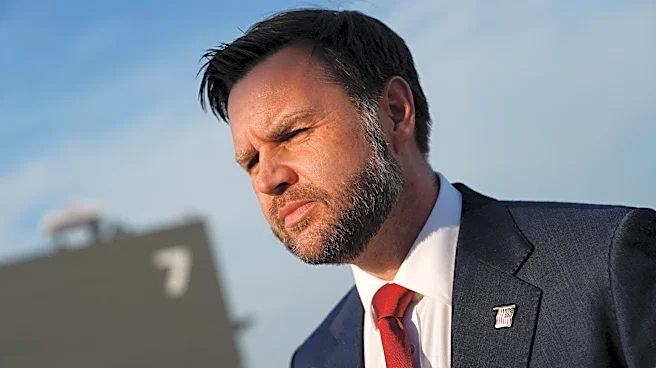
JD Vance, during an appearance on 'The Bryce Crawford Podcast,' made comments about the Antichrist and the End Times, stating he wouldn't be 'shocked if the Antichrist was walking among us.' These remarks, made while discussing his memoir 'Communion'
and his conversion to Catholicism, have caused confusion and frustration among many Catholics. Critics online noted that Vance's apocalyptic views are not central to Catholic doctrine, which briefly mentions the Antichrist as a 'pseudo-messianism' rather than a specific person. His statements were observed to align more with Evangelical interpretations of the apocalypse. The article highlights that Vance's perspective strongly resembles that of his mentor, donor, and former employer, billionaire Peter Thiel, who is known for his obsession with the Antichrist. Thiel's views, which draw from Nazi jurist Carl Schmitt and equate the Antichrist with progressive ideas like climate change and AI, have previously led Catholic institutions to distance themselves from his lectures.
Why It's Important?
This incident is significant as it underscores a growing ideological schism within American Catholicism, particularly concerning the interpretation of core theological concepts and the authority of the Vatican. Vance's public statements, which deviate from mainstream Catholic teachings and align with more Evangelical or traditionalist views, reflect a broader trend where some Catholics are increasingly skeptical of the Church's recent liberal leanings and looking to alternative sources for theological inspiration. This divergence can lead to internal conflicts and challenges to the unity of the Catholic Church in the U.S. Furthermore, the influence of figures like Peter Thiel, who is not Catholic but whose esoteric views on the Antichrist are adopted by prominent Catholic converts like Vance, highlights how external ideologies can shape religious discourse. This situation also raises questions about the intersection of politics and religion, as Vance's comments are made by a public figure, potentially influencing his political base and the perception of Catholicism among the wider public.
What's Next?
The controversy surrounding JD Vance's remarks is likely to continue fueling debates within Catholic circles about theological interpretation and the direction of the Church. This could lead to further discussions among Catholic leaders and scholars regarding the need to clarify official doctrines and address the rise of traditionalist or non-canonical interpretations. Vance's public profile means his statements will continue to be scrutinized, potentially affecting his standing among different Catholic factions and the broader electorate. The influence of figures like Peter Thiel on political and religious thought may also come under increased examination. This event could prompt Catholic institutions to more actively engage in theological education to counter what they perceive as misinterpretations of their faith. It also highlights the ongoing challenge for religious institutions to maintain doctrinal coherence in an era of diverse information sources and personalized belief systems.
Beyond the Headlines
Beyond the immediate theological debate, Vance's comments and Thiel's influence reveal deeper societal trends concerning the weaponization of religious narratives for political ends. The equating of the Antichrist with progressive ideas like climate change and AI, as Thiel does, transforms theological concepts into political tools, potentially demonizing opposing viewpoints and fostering division. This approach can contribute to a climate of fear and distrust, where complex societal challenges are framed in apocalyptic terms rather than through reasoned discourse. The rejection of Vatican authority by some traditionalist Catholics, as exemplified by Vance's past criticisms of Pope Leo XIV, also points to a broader anti-institutional sentiment that can undermine established religious and political structures. This trend has implications for social cohesion and the ability of diverse groups to find common ground, as religious beliefs become increasingly intertwined with partisan identities and cultural wars.