







What's Happening?
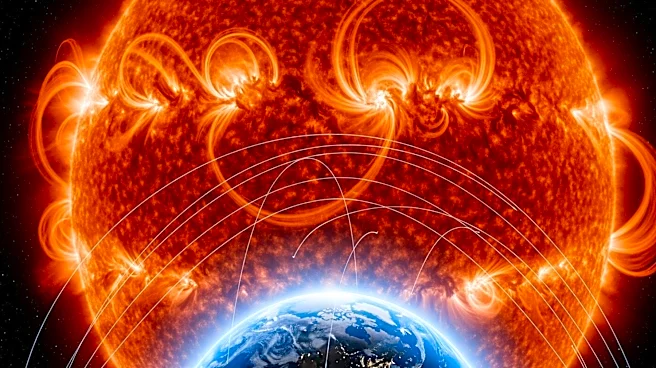
The Northern Lights, or auroras, are expected to be visible across more than 15 states in the U.S. on Monday night, following a coronal mass ejection (CME) from the sun. The National Oceanic and Atmospheric Administration (NOAA) has issued geomagnetic
storm watches for Monday and Tuesday, predicting a strong G3-level storm on Monday and a moderate G2-level storm on Tuesday. These geomagnetic storms occur when charged particles from the sun interact with Earth's magnetosphere, creating vibrant displays of light. The visibility of the auroras will depend on the timing and intensity of the storm, with potential sightings as far south as New York and Idaho during a G2 storm, and Illinois and Oregon during a G3 storm.
Why It's Important?
The potential visibility of the Northern Lights across a large portion of the U.S. presents a rare opportunity for many Americans to witness this natural phenomenon. Such events can increase public interest in space weather and its effects on Earth. The geomagnetic storms responsible for the auroras can also impact technology, including satellite operations and power grids, highlighting the importance of monitoring solar activity. For communities and businesses, understanding these impacts can aid in preparedness and response strategies. Additionally, the event offers educational opportunities for schools and science enthusiasts to learn more about space weather and its interactions with Earth's atmosphere.
What's Next?
As the geomagnetic storm progresses, NOAA will continue to monitor and update forecasts, providing real-time information on the storm's intensity and potential aurora visibility. Observers are advised to check local weather conditions and find locations away from city lights for optimal viewing. The event may also prompt discussions among scientists and policymakers about the need for improved space weather forecasting and infrastructure resilience. In the long term, increased awareness and understanding of space weather phenomena could lead to advancements in technology and strategies to mitigate their impacts on society.