






What's Happening?
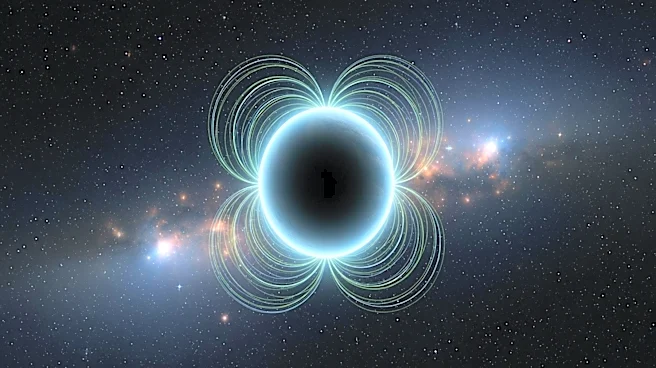
A team of astronomers has made a groundbreaking discovery by directly measuring magnetic fields around seven exoplanets, known as 'ultra-hot Jupiters.' These findings, published in Nature Astronomy, reveal that the magnetic fields are slowing down the planets'
wind speeds, which is counterintuitive given their high temperatures. The research utilized spectrographs from the European Southern Observatory's Very Large Telescope and the Gemini North telescope to measure wind speeds by tracking iron movement in the planets' atmospheres. This discovery opens new avenues in exoplanet research, providing insights into planetary atmospheres and their potential habitability.
Why It's Important?
The discovery of magnetic fields around exoplanets is a significant step forward in the search for habitable worlds beyond our solar system. Magnetic fields play a crucial role in protecting planetary atmospheres from stellar radiation, which is essential for maintaining conditions that could support life. Understanding these fields can help scientists identify planets that might retain water and other life-sustaining elements. This research could guide future explorations and the development of new technologies aimed at detecting life on other planets, potentially transforming our understanding of the universe and our place within it.