


What's Happening?
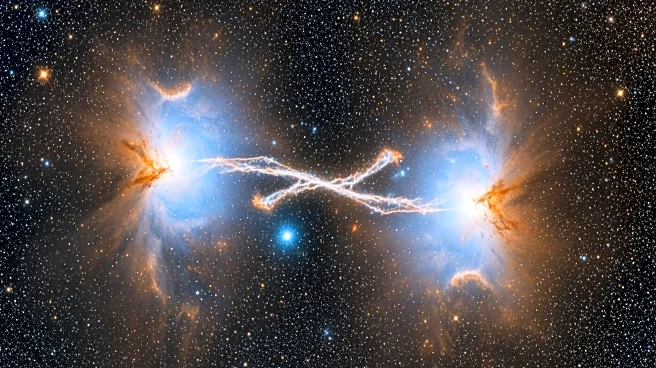
Astronomers using the Atacama Large Millimeter/submillimeter Array (ALMA) have identified a bridge of gas and dust connecting two newborn stars, L1448 IRS3A and L1448 IRS3B, located approximately 1,000 light-years away in the Perseus constellation. This
bridge, a spiral arm linking the stars, is considered a rare example of a stellar flyby, a phenomenon where young stars pass closely by each other, affecting their surrounding material. The discovery was made by a team led by Youngwoo Choi from Seoul National University, and the findings are set to be published in the Astrophysical Journal Letters. The bridge is about 1,800 astronomical units long and 240 astronomical units wide, likely formed by the gravitational interactions between the stars. This event provides a unique opportunity to study the dynamics of young star systems and their potential to form planetary systems.
Why It's Important?
The discovery of the gas bridge between these protostars is significant as it offers a glimpse into the early stages of star and planetary system formation. Understanding stellar flybys is crucial because they can influence the distribution of material around young stars, potentially affecting the formation of planets. This research could enhance our knowledge of how similar processes might have occurred in our own solar system's past. The ability to observe such interactions in real-time provides astronomers with valuable data to refine models of star formation and the evolution of planetary systems. The findings could also help distinguish between different types of stellar interactions, such as flybys and wide binary systems, which are important for understanding the diversity of star systems in the galaxy.
What's Next?
Future observations with high-sensitivity instruments like ALMA could provide more detailed insights into the kinematics of the system, helping to confirm whether the stars are indeed a bound pair or if they are experiencing a flyby. Continued study of this system may reveal additional structures or interactions, offering further clues about the processes governing star formation. Researchers plan to incorporate more complex simulations that include the gravitational effects of the protostars and surrounding dense matter to better understand the observed features. These efforts could lead to a more comprehensive understanding of the mechanisms driving the formation and evolution of young star systems.