



What's Happening?
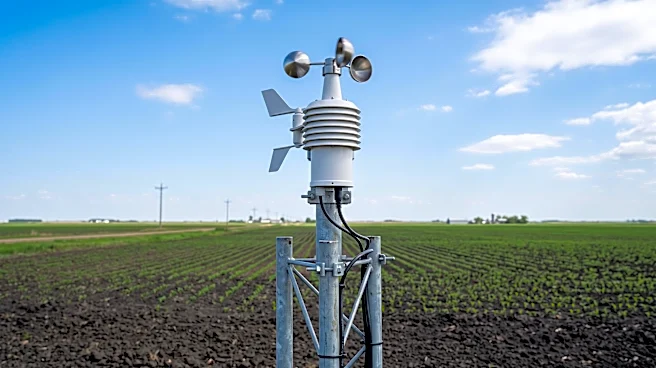
Daryl Ritchison, the director of the North Dakota Agricultural Weather Network (NDAWN) and the state climatologist for North Dakota, recently discussed his work on monitoring the region's climate. His responsibilities include tracking crucial data points
such as rainfall, soil moisture, and various other environmental factors. This information is vital for the agricultural economy of the region, providing insights that help farmers and agricultural businesses make informed decisions. Ritchison's work also extends to applications relevant for home gardens, demonstrating the broad utility of climate monitoring data.
Why It's Important?
The work conducted by Daryl Ritchison is of significant importance to North Dakota's agricultural sector, a cornerstone of the state's economy. Accurate and timely climate data, including rainfall and soil moisture levels, directly impacts crop yields, irrigation strategies, and overall farm productivity. By providing these insights, NDAWN helps mitigate risks associated with weather variability and climate change, enabling farmers to optimize their operations and enhance food security. The economic stability of the region is heavily reliant on agricultural success, making Ritchison's role critical in supporting sustainable farming practices and ensuring the resilience of the local economy against environmental challenges. The broader application of this data to home gardens also highlights its relevance to individual citizens and local food production.
What's Next?
The ongoing monitoring and analysis of climate data by Daryl Ritchison and NDAWN will continue to be crucial for North Dakota's agriculture. Future efforts will likely focus on refining data collection methods, improving predictive models, and disseminating information more effectively to stakeholders. As climate patterns evolve, the demand for precise and localized climate intelligence will only increase, making continuous research and technological advancements in this field paramount. Collaboration with agricultural extension services and educational institutions may also expand to ensure that the latest climate insights are integrated into farming practices and public awareness campaigns, further strengthening the region's agricultural resilience.
Beyond the Headlines
The detailed climate monitoring work in North Dakota, as highlighted by Daryl Ritchison, points to the increasing integration of scientific data into practical economic sectors. This exemplifies a broader trend where environmental science directly informs policy and operational decisions in industries heavily dependent on natural resources. The focus on agricultural weather networks underscores the vulnerability of food systems to climate fluctuations and the proactive measures being taken to adapt. This also raises questions about the long-term sustainability of current agricultural practices in the face of changing climate patterns and the potential for technological innovations to further enhance resilience and productivity in the sector. The insights gained from such regional monitoring efforts can also contribute to national and international climate research and adaptation strategies.