

What's Happening?
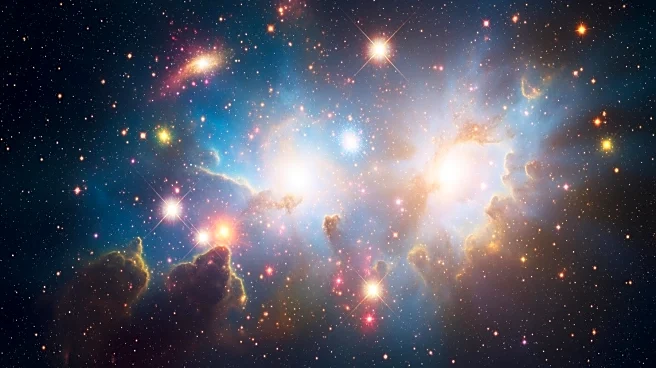
The Hubble Space Telescope has captured a striking image of the N159 star-forming complex within the Large Magellanic Cloud, a satellite galaxy of the Milky Way. This image reveals the intricate process of star formation, showcasing thick clouds of cold
hydrogen gas forming ridges and filaments. The deep red hues in the image are due to hydrogen gas energized by the radiation from newly formed stars. The N159 complex, located about 160,000 light-years from Earth, is a prime location for studying star formation due to its proximity and unique environment. The image highlights the dynamic interactions within the star-forming region, where massive young stars influence their surroundings through intense radiation and stellar winds.
Why It's Important?
This observation is significant as it provides insights into the processes of star formation and the early universe. The feedback from massive young stars, which can both inhibit and promote star formation, is crucial for understanding the lifecycle of stars and the evolution of galaxies. By studying regions like the N159 complex, astronomers can gain a better understanding of how stars and planetary systems form and evolve. This knowledge is essential for piecing together the history of our own galaxy and the universe at large.
What's Next?
Future observations and studies of the Large Magellanic Cloud and similar star-forming regions will continue to enhance our understanding of stellar and galactic evolution. The data collected by the Hubble Space Telescope and other observatories will be used to refine models of star formation and to explore the conditions that lead to the birth of stars. These studies will also inform the search for exoplanets and the potential for life in other parts of the universe.