
What's Happening?
Astronomers have identified the source of rare, short-lived blue light events, known as luminous fast blue optical transients (LFBOTs), as black holes tearing apart nearby stars. This discovery follows
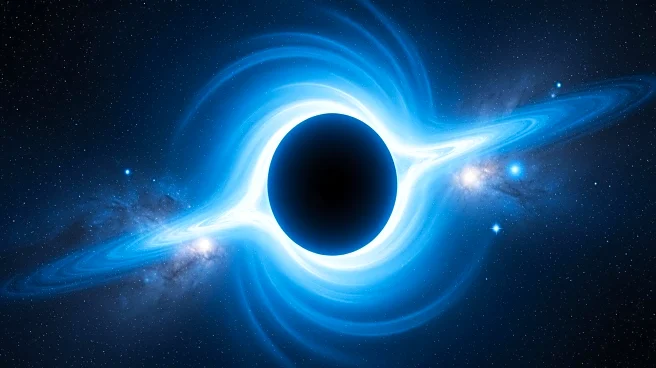
years of uncertainty about these events. The specific event, AT 2024wpp, was detected in 2024 and is the brightest example observed so far, appearing at the edge of a distant galaxy approximately 1.1 billion light-years from Earth. The event released significantly more energy than typical supernovae and faded within days, prompting researchers to question previous explanations. Using data from various observations, scientists concluded that AT 2024wpp was produced during an extreme tidal disruption event, where a black hole pulls a star apart as it passes too close. This research helps narrow down the physical processes behind these rare signals and challenges models that rely on standard stellar explosions.
Why It's Important?
The identification of black holes as the source of LFBOTs is significant as it provides a clearer understanding of these rare cosmic events, which have puzzled scientists for years. This discovery not only advances the field of astronomy but also enhances our understanding of black hole behavior and their interactions with surrounding stars. The findings suggest that some LFBOTs form under very specific conditions involving smaller black holes and massive companion stars, which could lead to new insights into the lifecycle of stars and the dynamics of galaxies. Additionally, this research could influence future observational strategies and theoretical models, potentially leading to further breakthroughs in the study of cosmic phenomena.
What's Next?
The research team plans to continue observing similar events to refine their understanding of the conditions that lead to LFBOTs. Future studies will likely focus on identifying other instances of tidal disruption events and exploring the specific characteristics of stars and black holes involved. The findings from AT 2024wpp will guide these observations, helping astronomers to better predict and identify similar occurrences. As more data is collected, scientists hope to develop a comprehensive model that explains the formation of LFBOTs and their role in the broader context of cosmic events.
Beyond the Headlines
This discovery highlights the complex and often violent interactions between black holes and stars, offering a glimpse into the extreme environments that exist in the universe. The study of LFBOTs not only contributes to our understanding of black holes but also raises questions about the fate of stars in such encounters. The research underscores the importance of multi-wavelength observations in capturing the full picture of these events, as different wavelengths reveal different aspects of the phenomena. As technology advances, astronomers will be better equipped to explore these distant and fleeting cosmic events, potentially uncovering new aspects of the universe's evolution.