


What's Happening?
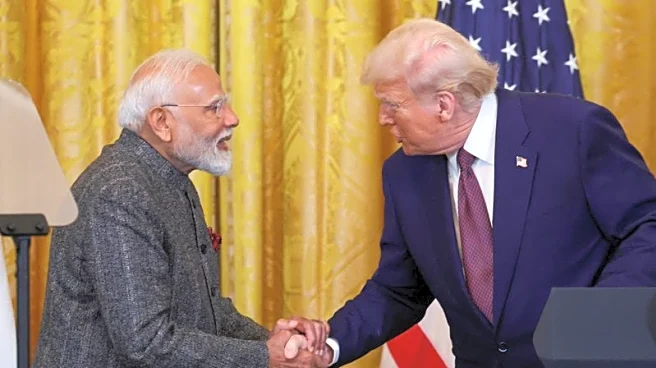
The United States and India have released a framework for an interim trade agreement aimed at reducing tariffs on goods between the two countries. This development follows U.S. President Trump's announcement to lower import tariffs on Indian goods, which
were initially imposed to pressure India to reduce its reliance on Russian crude oil. Under the new framework, tariffs on Indian goods will be reduced from 25% to 18%, while India will eliminate or reduce tariffs on U.S. industrial goods and a variety of food and agricultural products. The agreement is described as 'reciprocal and mutually beneficial,' with both nations committed to working towards a broader trade deal that will enhance market access and support resilient supply chains. Indian Prime Minister Narendra Modi expressed gratitude to President Trump for his commitment to strengthening bilateral ties, while Indian Trade Minister Piyush Goyal highlighted the potential for increased exports and job creation.
Why It's Important?
This interim trade agreement is significant as it represents a step towards strengthening economic ties between the U.S. and India, two major global economies. By reducing tariffs, the agreement aims to facilitate greater market access for both countries, potentially boosting trade volumes and economic growth. For the U.S., this could mean increased exports of industrial and agricultural products, while India stands to benefit from enhanced export competitiveness in sectors like pharmaceuticals and gems. The agreement also reflects a strategic shift in India's trade policy, as it seeks to diversify its economic partnerships and reduce dependency on Russian energy imports. However, the deal has faced criticism from Indian opposition parties, who argue that it disproportionately favors U.S. interests and could negatively impact sensitive sectors such as agriculture.
What's Next?
Further negotiations are expected to formalize the interim trade agreement, with both countries working towards a comprehensive trade deal that includes additional market access commitments. The agreement's implementation will likely involve detailed discussions on specific tariff reductions and the protection of sensitive sectors. Stakeholders in both countries, including businesses and political leaders, will be closely monitoring the progress of these negotiations. Additionally, the agreement may influence India's ongoing trade discussions with other global partners, such as the European Union, as it seeks to expand its economic footprint and secure favorable trade terms.