







What's Happening?
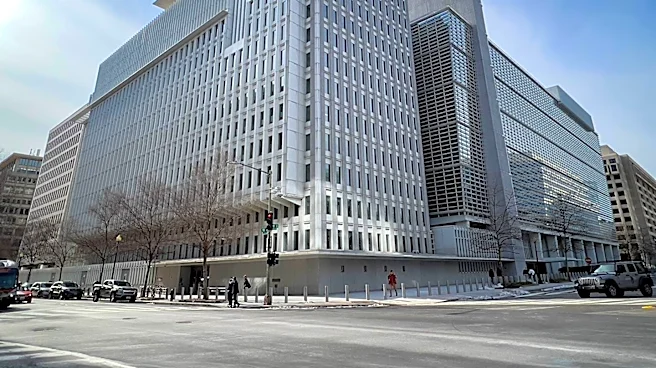
The World Bank Group has appointed Juan Carlos Alvarez as the new country manager for Trinidad and Tobago. This appointment aims to unify country-level leadership across the institution to enhance its development impact, particularly in supporting job
creation and the public and private sector priorities of Trinidad and Tobago. In his new role, Alvarez will lead the World Bank Group institutions in Trinidad and Tobago, which include the International Bank for Reconstruction and Development (IBRD), the International Finance Corporation (IFC), and the Multilateral Investment Guarantee Agency (MIGA). His responsibilities will involve promoting an integrated agenda to mobilize financing, knowledge, and private investment. Prior to this appointment, Alvarez served as the World Bank country manager for Angola and São Tomé and Príncipe, where he managed the institution's engagements with both countries. He joined the World Bank Group in 2000 and has since worked as legal counsel across various regions, including Latin America and the Caribbean and South Asia, advising on legal, operational, and policy matters.
Why It's Important?
This appointment is significant for the U.S. as it reflects the ongoing efforts of international financial institutions, often influenced by U.S. policy, to promote economic stability and development in the Caribbean and Latin American regions. A unified leadership under Alvarez could streamline the World Bank's operations in Trinidad and Tobago, potentially leading to more effective allocation of resources and implementation of development projects. This could foster a more stable economic environment, which is generally beneficial for U.S. trade and investment interests in the region. Furthermore, by focusing on job creation and private sector development, the World Bank's initiatives under Alvarez could help address underlying economic challenges that sometimes contribute to regional instability or migration pressures, issues that directly impact U.S. foreign policy and national security. The U.S., as a major contributor to the World Bank, has a vested interest in the effective leadership and outcomes of such appointments.
What's Next?
Alvarez's immediate focus will be on integrating the efforts of the IBRD, IFC, and MIGA in Trinidad and Tobago to maximize their collective impact. This will likely involve developing and implementing new strategies for mobilizing financing, sharing knowledge, and attracting private investment to support the country's development goals. Stakeholders, including the government of Trinidad and Tobago, local businesses, and civil society organizations, will be looking to Alvarez to articulate a clear vision and actionable plans. His previous experience in Angola and São Tomé and Príncipe, as well as his extensive legal background in Latin America and the Caribbean, suggest a nuanced approach to regional development challenges. The success of his tenure could serve as a model for other World Bank country offices in the region, potentially influencing future appointments and operational strategies.
Beyond the Headlines
The appointment of a country manager with extensive experience across diverse regions, including Latin America and the Caribbean, highlights the World Bank's strategy to leverage global expertise for localized development challenges. Alvarez's background as legal counsel suggests an emphasis on governance, rule of law, and policy frameworks as foundational elements for economic development. This approach is crucial in regions where institutional strengthening is as important as financial investment. The focus on job creation and private sector priorities also reflects a broader shift in development paradigms, moving beyond traditional aid models to foster sustainable, market-driven growth. This could lead to a more robust and resilient economy in Trinidad and Tobago, reducing its vulnerability to external shocks and fostering greater self-reliance. The appointment also underscores the continuous evolution of international development efforts and the critical role of leadership in translating global mandates into tangible local impact.