
What's Happening?
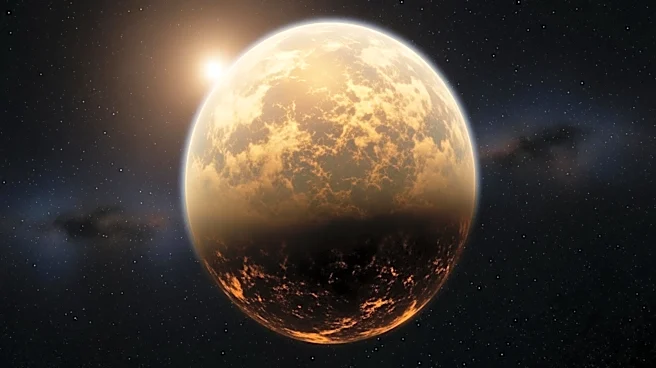
Preliminary findings presented at the European Geosciences Union General Assembly suggest that Venus-like planets, characterized by dense carbon dioxide atmospheres, may be more common in the galaxy than
Earth-like planets with liquid water oceans. The study, led by Sean Jordan and colleagues from ETH Zurich, is based on geochemical models of atmospheric formation. These models indicate that as rocky planets cool from their molten state, they are more likely to develop thick CO2 atmospheres. The research highlights the potential prevalence of Venus-like conditions in the galaxy, though these findings are based on modeling rather than direct observation.
Why It's Important?
This research challenges the assumption that Earth-like planets are the norm in the galaxy, suggesting instead that Venus-like conditions may be more typical. This has significant implications for the search for extraterrestrial life and the study of planetary formation. Understanding the prevalence of Venus-like planets could reshape priorities in space exploration and research, potentially leading to increased focus on studying Venus itself as a reference point. The findings also underscore the need for advanced observational technologies to confirm the atmospheric conditions of exoplanets.
What's Next?
The study's implications may influence future space missions and research priorities. Proposed missions to Venus, such as NASA's DAVINCI and VERITAS, could provide critical data to validate these models. However, these missions face potential cancellation, highlighting a disconnect between scientific priorities and political decision-making. The research community may advocate for continued exploration of Venus to better understand its atmospheric conditions and their implications for exoplanet studies. Additionally, advancements in telescope technology will be crucial for confirming the presence of Venus-like atmospheres on exoplanets.