
What's Happening?
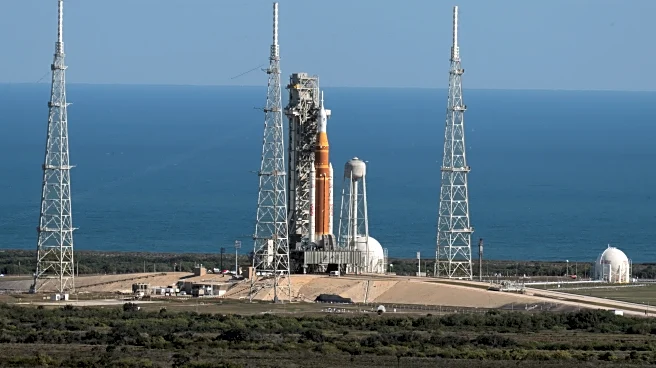
NASA's Interstellar Mapping and Acceleration Probe (IMAP) has commenced its primary science mission to explore the heliosphere, the protective bubble created by the solar wind that surrounds our solar system. Launched in September 2025, IMAP uses ten
scientific instruments to study high-energy particles, magnetic fields, and interstellar dust. The mission aims to understand how the solar wind interacts with interstellar space and the energization of charged particles from the Sun. IMAP's data is also being used in real-time to inform space weather forecasts, which are crucial for the safety of spacecraft and astronauts.
Why It's Important?
IMAP's mission is significant for advancing our understanding of the heliosphere and its role in protecting our solar system from cosmic radiation. By mapping the boundaries of this protective bubble, scientists can gain insights into the fundamental processes that govern space weather and its impact on Earth. The mission's findings could enhance our ability to predict space weather events, which are critical for safeguarding satellites, communication systems, and human space exploration. IMAP's research also contributes to the broader field of heliophysics, offering valuable data on the Sun's influence beyond our solar system.