








What's Happening?
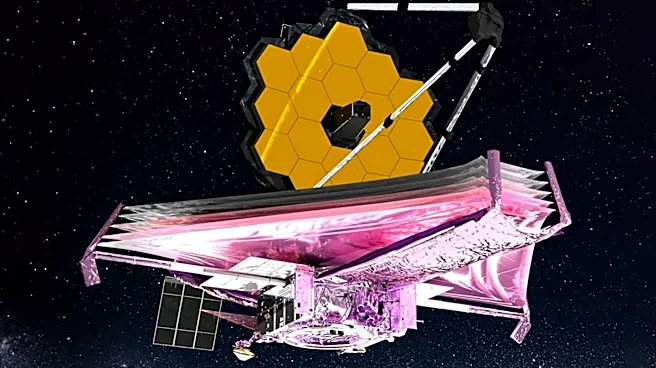
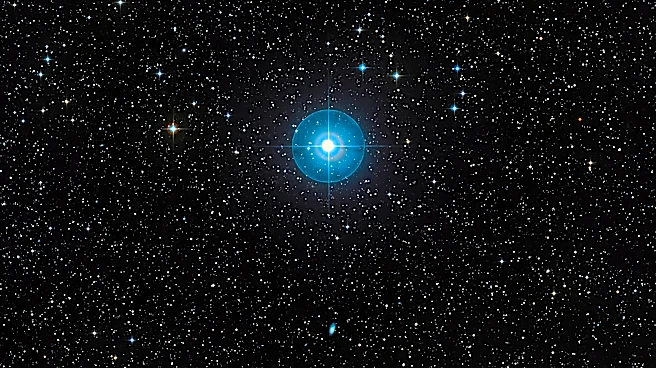
Astronomers utilizing the James Webb Space Telescope have identified a new giant exoplanet within the Beta Pictoris system, a significant discovery in exoplanet research. The planet, named Beta Pictoris d, was detected through atmospheric fingerprinting
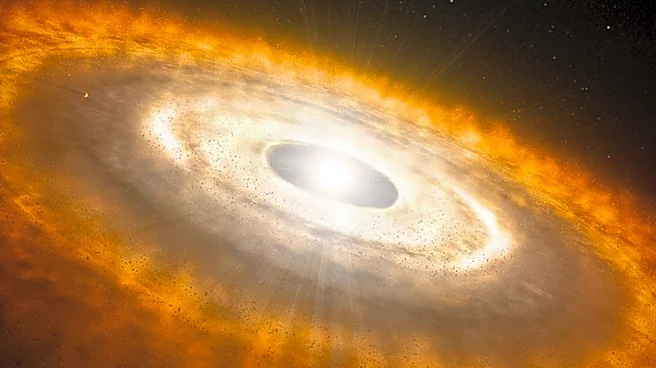
rather than traditional imaging methods. This system, located approximately 63 light-years from Earth, was already known to host two giant planets, Beta Pictoris b and c. The discovery of Beta Pictoris d, which is estimated to be at least twice the mass of Jupiter, marks it as the lightest of the three known planets in the system. The planet was identified using Webb’s Near-Infrared Spectrograph (NIRSpec), which detected the unique chemical signature of its atmosphere. This finding helps explain the unusual structures in the system's debris disk, providing a clearer picture of its architectural evolution.
Why It's Important?
The discovery of Beta Pictoris d is a milestone in the study of planetary systems, offering insights into how such systems form and evolve. This finding is particularly significant as it demonstrates a new method for detecting planets in complex environments, potentially leading to the discovery of more hidden worlds. The ability to identify planets through atmospheric signatures rather than direct imaging could revolutionize the search for exoplanets, especially those obscured by their host stars or surrounding debris. This advancement not only enhances our understanding of the Beta Pictoris system but also contributes to the broader field of astronomy by providing a new tool for exploring the universe.
What's Next?
Following this discovery, astronomers are likely to apply this atmospheric fingerprinting technique to other star systems, potentially uncovering more hidden planets. The success of this method could lead to a reevaluation of existing data from other systems, where similar planets may have been overlooked. Additionally, further observations of Beta Pictoris d using Webb’s Mid-Infrared Instrument (MIRI) and other telescopes could provide more detailed information about its composition and orbit, enhancing our understanding of its role within the system.