
What's Happening?
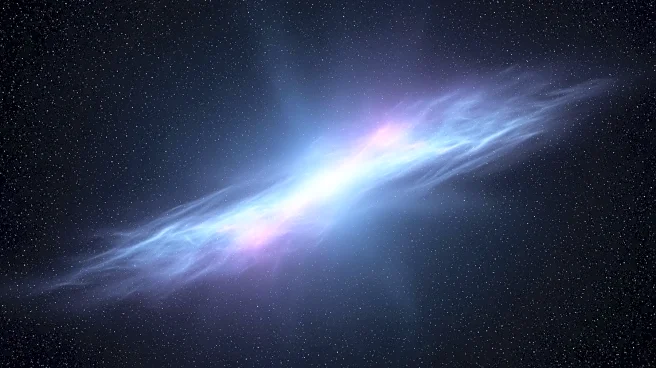
NASA's Hubble Space Telescope has identified a new type of astronomical object, a starless, gas-rich dark matter cloud named Cloud-9. This discovery marks the first confirmed detection of such an object, providing
insights into early galaxy formation and the nature of dark matter. Cloud-9, a Reionization-Limited H I Cloud (RELHIC), is a remnant from the early universe, composed primarily of neutral hydrogen and dark matter. The findings, published in The Astrophysical Journal Letters, were presented at the American Astronomical Society meeting. The discovery suggests the existence of other similar dark matter-dominated structures, offering a rare glimpse into the universe's dark components.
Why It's Important?
The discovery of Cloud-9 is significant for understanding the universe's composition, particularly dark matter, which constitutes most of the universe's mass but is difficult to detect. By studying such starless clouds, scientists can gain insights into the early stages of galaxy formation and the intrinsic properties of dark matter. This research challenges traditional observations that focus on bright objects like stars and galaxies, highlighting the importance of exploring less visible components of the universe. The findings could lead to new theories about galaxy formation and the role of dark matter in the universe's evolution.
What's Next?
Future research will likely focus on identifying more RELHICs and understanding their formation and evolution. The discovery of Cloud-9 opens new avenues for studying dark matter and its role in the universe. As technology advances, astronomers may develop more sensitive instruments to detect these elusive objects, potentially leading to breakthroughs in cosmology. The findings also underscore the importance of international collaboration in space research, as the Hubble Space Telescope is a joint project between NASA and the European Space Agency.