








What's Happening?
The Colonial Williamsburg Foundation has announced a five-year plan to expand its historical depiction and programming, following the successful completion of its centennial fundraising campaign, 'Power of Place.' The foundation surpassed its $600 million
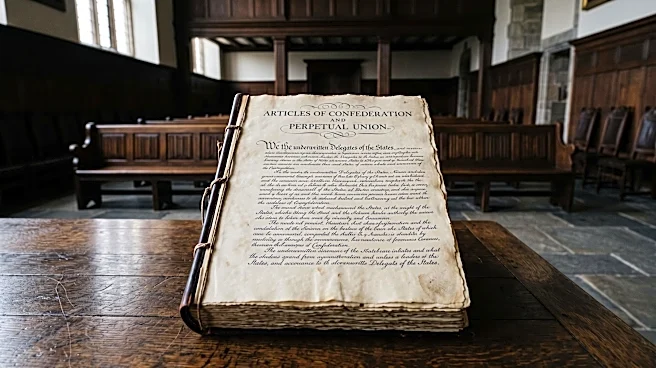
goal eight months ahead of schedule, raising the funds since 2023. Historically, Colonial Williamsburg has focused on the period leading up to the American Revolution. The new plan will extend this focus to include the time leading up to the ratification of the U.S. Constitution and Bill of Rights in late 1791. As part of this expansion, Colonial Williamsburg will establish the National Institute for the Constitution and Civic Virtue. Jeffrey Rosen, a constitutional scholar and professor at George Washington University, has been appointed as the institute's founding director, a position funded by a $10 million donation from Elizabeth and Michael Luttig. The institute aims to organize national lecture series, develop classroom materials for K-12 teachers, and create programs promoting responsible citizenship.
Why It's Important?
This expansion by Colonial Williamsburg signifies a significant shift in how a major U.S. historical institution interprets and presents American history. By broadening its scope to include the post-Revolutionary War period and the foundational documents of the U.S. government, the foundation aims to offer a more comprehensive understanding of the nation's early development. The establishment of the National Institute for the Constitution and Civic Virtue, led by a prominent constitutional scholar, underscores a commitment to civic education and engagement. This initiative could influence public discourse on constitutional principles and citizenship, potentially shaping how future generations perceive their roles in American democracy. The substantial fundraising success highlights continued public and philanthropic interest in historical preservation and education, even as the institution adapts its narrative to remain relevant in contemporary society. This move could also set a precedent for other historical sites to re-evaluate and expand their educational offerings.
What's Next?
Over the next five years, through 2031, Colonial Williamsburg will be actively engaged in rebuilding and updating its living history and guest experiences to reflect the expanded historical period. The National Institute for the Constitution and Civic Virtue will begin organizing its national lecture series, which will take place in Williamsburg, Washington, D.C., and at partner institutions. The institute will also focus on developing and distributing scholarly work as classroom materials for K-12 teachers, aiming to integrate its historical insights into educational curricula nationwide. Furthermore, new programs designed to explore the importance of responsible citizenship in the American experiment of self-government are expected to be launched. These developments coincide with the ongoing U.S. semiquincentennial celebrations, leading up to the 250th anniversary of the Battle of Yorktown in 2031, providing a timely backdrop for Colonial Williamsburg's enhanced focus on foundational American history.
Beyond the Headlines
The decision by Colonial Williamsburg to expand its historical narrative beyond the American Revolution to include the Constitution and Bill of Rights reflects a deeper societal need to engage with the complexities of American governance and civic responsibility. In an era marked by political polarization and debates over constitutional interpretation, an institution like Colonial Williamsburg, with its educational reach, can play a crucial role in fostering a more informed citizenry. The emphasis on 'civic virtue' and 'lifelong learning' through the new institute suggests an effort to move beyond mere historical recounting to active civic engagement. This initiative could spark broader discussions about the relevance of historical documents to contemporary challenges and the evolving understanding of American identity. The involvement of constitutional scholars and the development of educational materials for K-12 students indicate a long-term vision for influencing civic literacy and promoting a more nuanced appreciation of the nation's founding principles.