
What's Happening?
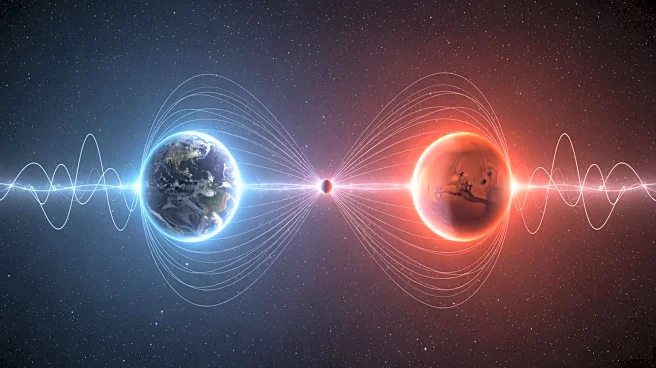
A recent study conducted by Stephen Kane, a professor of planetary astrophysics at UC Riverside, has uncovered the significant impact of Mars' gravitational pull on Earth's long-term climate patterns.
Despite its smaller size and mass compared to Earth, Mars influences the Milankovitch cycles, which are crucial in understanding the onset and conclusion of ice ages. These cycles affect Earth's orbital eccentricity, axial tilt, and the timing of its closest approach to the Sun, thereby influencing the amount of sunlight different parts of Earth receive. Kane's computer simulations demonstrated that the presence of Mars is essential for certain climate cycles, such as the 100,000-year and 2.3 million-year cycles, which disappear when Mars is removed from the model.
Why It's Important?
The findings of this study have profound implications for understanding Earth's climate history and the factors that have shaped it. By highlighting Mars' role in Earth's climate cycles, the research suggests that even small celestial bodies can have significant effects on planetary climates. This insight is crucial for the study of exoplanets and the potential habitability of other worlds. The research indicates that outer planets in other solar systems could similarly influence the climates of Earth-like planets, affecting their potential to support life. This could reshape how scientists approach the search for habitable planets beyond our solar system.
What's Next?
The study opens new avenues for research into the gravitational interactions between planets and their effects on climate. Future research could explore the implications of these findings for other planetary systems, particularly those with Earth-sized planets in habitable zones. Understanding the role of outer planets in shaping climate could aid in identifying exoplanets with stable climates conducive to life. Additionally, the study raises questions about how Earth's climate and life forms might have evolved differently without Mars' influence, prompting further investigation into the historical and evolutionary impacts of planetary interactions.
Beyond the Headlines
The study's implications extend beyond immediate scientific understanding, touching on philosophical and existential questions about the uniqueness of Earth's climate and life. By suggesting that Mars has played a stabilizing role in Earth's climate, the research invites speculation about the delicate balance of factors that have allowed life to thrive on our planet. It also underscores the interconnectedness of celestial bodies and the complex dynamics that govern planetary systems, offering a broader perspective on our place in the universe.