

What's Happening?
The James Webb Space Telescope (JWST) has made a significant discovery by identifying a variety of molecules that could serve as the initial building blocks of life in a nearby galaxy. Using its Near InfraRed Spectrograph (NIRSpec) and Mid-Infrared Instrument
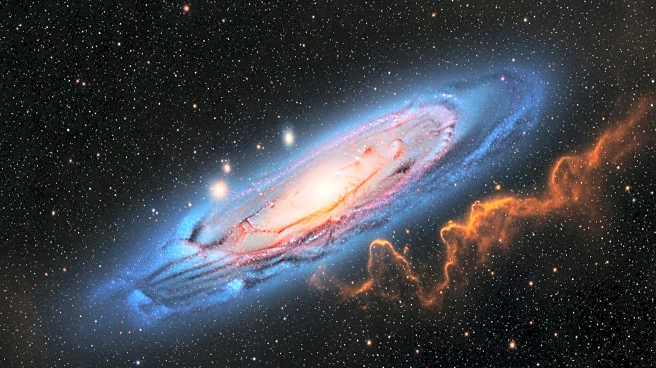
(MIRI), the telescope examined the ultra-luminous infrared galaxy IRAS 07251-0248. This galaxy's dense core is obscured by dust and gas, which absorbs many wavelengths of light except infrared, making JWST the ideal tool for this investigation. The research team, led by Ismael García Bernete from the Center for Astrobiology, found an unexpected chemical complexity with higher abundances than predicted by current models. The molecules discovered include benzene, methane, acetylene, and the highly reactive methyl radical, which has never been detected beyond the Milky Way before. These findings suggest a continuous source of carbon in these galactic nuclei, fueling a rich chemical network.
Why It's Important?
This discovery is crucial as it enhances our understanding of how complex carbon-based molecules form in extreme regions of the galaxy. The presence of these molecules, which are vital in the development and sustaining of life, could provide insights into prebiotic chemistry, representing an important step towards the formation of amino acids and nucleotides. The findings suggest that heavily obscured galactic nuclei could act as production lines for organic molecules, potentially chemically enhancing their home systems. This could have significant implications for the study of life's origins and the conditions necessary for life to develop elsewhere in the universe.
What's Next?
The research team suggests that the chemistry observed cannot be explained by extreme temperatures and gas turbulence alone. They propose that cosmic rays may fragment larger molecules, releasing small organic molecules. Further studies are likely to focus on understanding the role of cosmic rays and other factors in the formation of these molecules. Continued observations with the JWST and other telescopes could provide more data to refine theoretical models and explore the potential for life-supporting conditions in other galaxies.