




What's Happening?
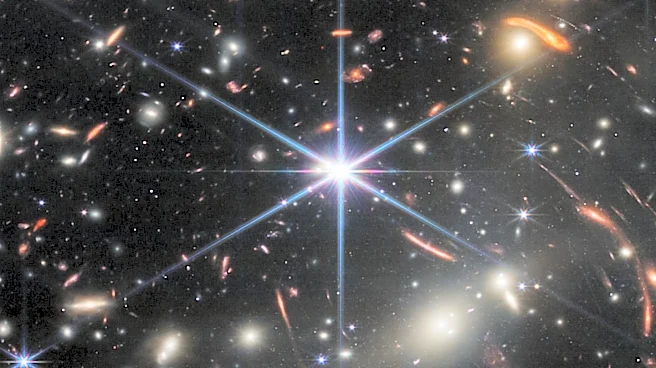
Astronomers, led by a team from Leiden University, have utilized the James Webb Space Telescope (JWST) to discover that distant galaxies contain a significantly larger number of low-mass stars than previously believed. This finding challenges existing
models of galaxy formation. The research, published in Nature Astronomy, involved studying nine massive, mature galaxies that had ceased star formation billions of years ago. By combining deep JWST spectra with observations from the Very Large Telescope, researchers were able to determine the proportions of faint, low-mass stars and bright, giant stars in these distant galaxies for the first time. Traditionally, the light spectrum from galaxies is dominated by massive, bright stars, making the detection of fainter, low-mass stars extremely difficult. The new models indicate that a numerous population of low-mass stars is concealed by these rare, bright stars, leading to the conclusion that these galaxies are much more massive than earlier estimates suggested. For one galaxy in the sample, it is estimated to be up to four times more massive than previously thought.
Why It's Important?
This discovery has crucial implications for our understanding of the early universe and galaxy formation. The presence of a much larger fraction of low-mass stars in the most massive galaxies of the early universe, compared to less massive galaxies like the Milky Way, challenges the historical assumption that stars formed in roughly the same proportions everywhere. Since the launch of JWST, astronomers have identified surprisingly massive and mature galaxies existing shortly after the Big Bang. These new results suggest that these galaxies were likely even more massive than initially reported, requiring current galaxy formation models to explain how such vast quantities of tiny stars could have formed so early in the universe's history. Furthermore, the research suggests that if many planets orbit low-mass stars, this could indicate that more planets formed in the early universe than previously assumed, impacting our understanding of exoplanet prevalence and habitability.
What's Next?
The research team plans to apply their new method to even earlier galaxies in the coming years. This will allow them to probe closer to the era when the first generations of stars and galaxies began to form, potentially offering further insights into the universe's origins. The findings will necessitate adjustments to existing astrophysical models and simulations of galaxy evolution. Future studies may also explore the implications of this hidden mass for the distribution of dark matter within these galaxies and its role in their formation and evolution. The ability to accurately measure the full stellar mass of distant galaxies will refine our understanding of cosmic structures and their development over billions of years.
Beyond the Headlines
The revelation of 'hidden mass' in the form of low-mass stars underscores the limitations of previous observational techniques and the transformative power of advanced instruments like the JWST. This shift in understanding highlights the dynamic nature of scientific knowledge, where new technologies can fundamentally alter long-held assumptions. The concept of 'hidden' components in the universe, whether stars, dark matter, or dark energy, consistently pushes the boundaries of astronomical inquiry. This discovery also subtly touches upon the broader philosophical implications of what we perceive versus what truly exists in the cosmos, reminding us that our current understanding is always a work in progress, subject to refinement with better tools and methodologies. The potential for a greater number of planets in the early universe also opens new avenues for astrobiological research, suggesting that the conditions for life might have been more widespread earlier than previously thought.