
What's Happening?
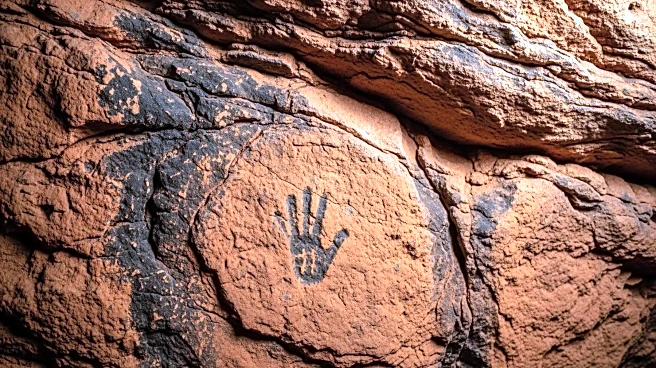
A hand stencil dating back nearly 68,000 years has been discovered in a cave in Sulawesi, Indonesia, marking it as the oldest known rock art. This stencil, which appears to have been modified to resemble
claws, predates similar Neanderthal art in Spain by 1,100 years. The discovery was made by a team led by Maxime Aubert from Griffith University, who identified 44 rock art sites in the region. The stencil's modification suggests a level of artistic intention and creativity, indicating that the creators were likely modern humans. This finding supports the idea that Sulawesi was a significant location in early human migration, potentially serving as a stepping stone for humans moving from Southeast Asia to Australia.
Why It's Important?
The discovery of this ancient art provides crucial insights into the cognitive and cultural capabilities of early humans. It suggests that symbolic thinking and artistic expression were present in human populations much earlier than previously believed. This challenges existing theories about the timeline of human migration and cultural development. The presence of such art in Sulawesi supports the 'long chronology' theory, which posits that humans reached Australia earlier than the previously estimated 50,000 years ago. This finding also highlights the importance of Sulawesi in understanding the migration routes and cultural practices of early humans.
What's Next?
Further research and exploration in Sulawesi and surrounding regions are expected to uncover more ancient art, providing additional insights into early human migration and cultural practices. Researchers will likely focus on identifying more sites and using advanced dating techniques to refine the timeline of human migration. This could lead to a reevaluation of the routes taken by early humans as they spread across the globe. The findings may also prompt a broader investigation into the cultural and symbolic practices of early human populations in other parts of the world.