
What's Happening?
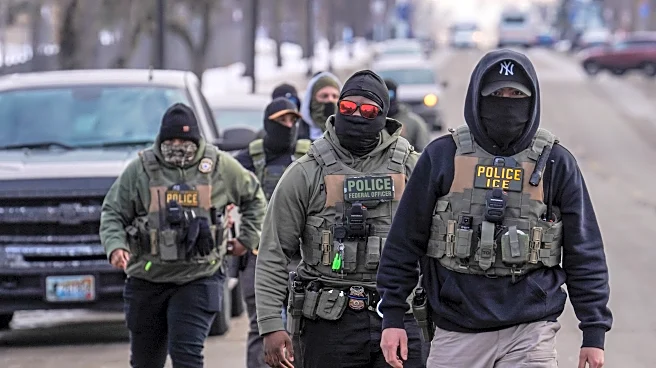
U.S. District Judge Kate Menendez has issued an injunction limiting the actions of federal immigration agents in the Minneapolis–St. Paul area. This order, effective immediately, curtails the use of crowd-control
measures such as chemical dispersants and restricts arrests and vehicle stops related to peaceful protests. The injunction comes in response to the deployment of nearly 3,000 agents from Immigration and Customs Enforcement (ICE) and U.S. Border Patrol as part of Operation Metro Surge, the largest operation of its kind by the Department of Homeland Security (DHS). The judge's decision is based on concerns over First and Fourth Amendment rights, emphasizing that federal agents cannot retaliate against peaceful protesters or observers without reasonable suspicion of criminal activity. The order also prohibits the use of nonlethal munitions like pepper spray and tear gas against nonviolent demonstrators and observers.
Why It's Important?
This ruling is significant as it addresses the balance between federal enforcement actions and constitutional rights during protests. The decision could impact how federal agencies conduct operations in urban areas, particularly in situations involving large-scale protests. The injunction highlights the legal and ethical challenges faced by federal agencies in maintaining public order while respecting civil liberties. The ruling may also influence future federal operations and their interactions with local law enforcement, potentially affecting resource allocation and operational strategies. Additionally, the decision could lead to changes in how federal agencies engage with communities during enforcement actions, especially in politically sensitive environments.
What's Next?
The Department of Homeland Security and ICE are required to comply with the injunction within 72 hours, which may necessitate significant operational adjustments. The federal government might consider appealing the decision or seeking modifications to the injunction, which would influence its scope and duration. The ruling could also prompt discussions on federal enforcement strategies and their alignment with constitutional protections. As investigations into the recent fatal shooting by an ICE agent continue, the outcome may further affect federal and local relations and enforcement policies.
Beyond the Headlines
The injunction may have broader implications for federal enforcement strategies across the U.S., particularly in areas with active protest movements. It raises questions about the legal and fiscal responsibilities of federal agencies when deploying large numbers of agents in urban settings. The decision could also influence public perception of federal enforcement actions and their impact on civil liberties, potentially leading to increased scrutiny and calls for reform. The case underscores the ongoing tension between maintaining public safety and protecting individual rights in the context of federal operations.