
What's Happening?
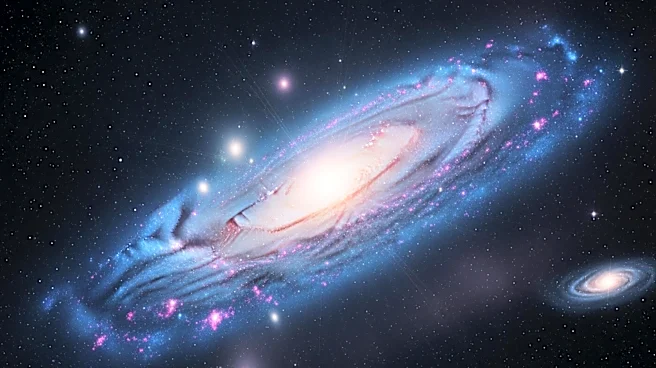
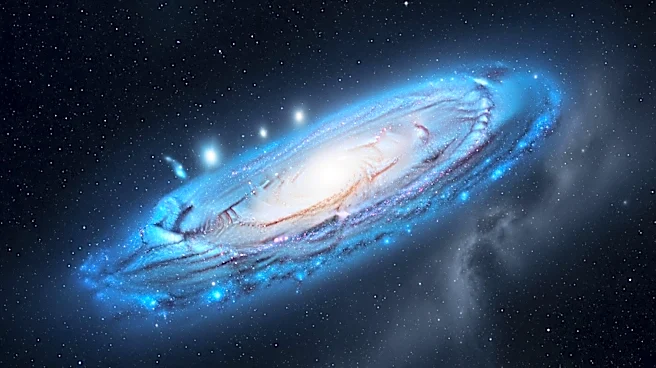
A new simulation project, COLIBRE, has provided insights into how galaxies formed in the early universe. By incorporating detailed models of gas, dust, and stellar outflows, scientists have created a virtual universe that mirrors our own. The simulation,
which required 72 million CPU hours, included complex physics and chemistry to model the cold gas from which stars form. The results align with observations from the James Webb Space Telescope (JWST), showing that large galaxies could form earlier than previously thought without contradicting existing cosmological models.
Why It's Important?
This research is crucial for understanding the early universe's evolution and the processes that led to the formation of galaxies. By accurately simulating the conditions of the early universe, scientists can better comprehend the transition from a hot plasma state to the structured cosmos we observe today. The findings support the validity of current cosmological models and provide a framework for interpreting JWST's observations, which had initially seemed to challenge these models. This enhances our understanding of cosmic history and the fundamental processes that shaped the universe.
What's Next?
While the COLIBRE simulation has advanced our understanding, questions remain, such as the nature of the 'Little Red Dots' observed by JWST. Future research will focus on these phenomena and further refine the simulation models to address remaining mysteries. Continued collaboration between observational and theoretical astrophysics will be essential to unravel these cosmic puzzles and improve our comprehension of the universe's formative years.