




What's Happening?
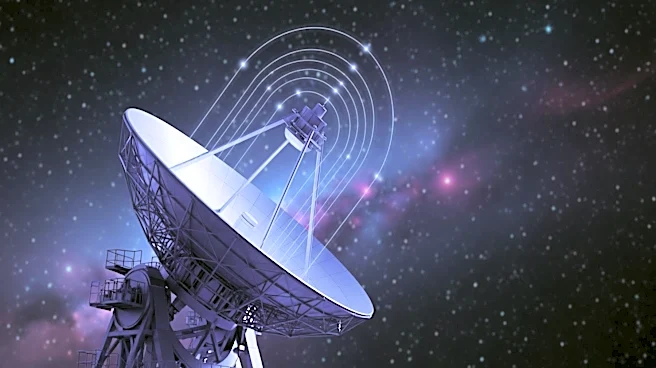
A team of astrophysicists from Northwestern University has provided evidence that Sagittarius A*, the supermassive black hole at the center of the Milky Way, emits a wind. This discovery was made using the Atacama Large Millimeter/submillimeter Array
(ALMA) and confirmed by NASA’s Chandra X-ray Observatory. The team, led by Mark D. Gorski and Lena Murchikova, identified a 45-degree cone of missing molecular gas, indicating a wind blowing from the black hole. This finding supports the theory that black holes produce outflows as they consume matter, which heats up and drives radiation that pushes surrounding gas outward. The research, published in The Astrophysical Journal Letters, shows that the Milky Way's black hole behaves similarly to other supermassive black holes in the universe.
Why It's Important?
The confirmation of a wind from Sagittarius A* has significant implications for understanding galactic evolution. It suggests that even quiet black holes, like the one at the center of the Milky Way, can influence their host galaxies by shaping gas reservoirs over billions of years. This discovery narrows the gap between the Milky Way's black hole and more active galactic nuclei, providing a better understanding of how black holes impact their environments. The findings also highlight the role of black holes in regulating star formation by either dispersing or compressing gas clouds, which can either inhibit or trigger star formation. This research contributes to the broader understanding of how galaxies evolve and the role of black holes in that process.
What's Next?
Future research will focus on measuring the wind directly and tracking the velocity of gas being swept along the cavity walls. Additional ALMA campaigns could provide more data on the wind's impact and confirm the presence of a potential counterwind cone on the opposite side of Sagittarius A*. These efforts will help refine models of black hole behavior and their influence on galactic environments. The study also opens up new avenues for exploring the long-term effects of black hole winds on galaxy formation and evolution.
Beyond the Headlines
This discovery challenges the perception of the Milky Way's black hole as an outlier among supermassive black holes. It underscores the importance of cold gas availability in governing black hole growth and quiescence. The findings align with recent surveys showing that black hole growth has slowed as the universe's supply of cold gas diminishes. This research highlights the interconnectedness of cosmic phenomena and the subtle yet significant role that even low-activity black holes play in shaping their galaxies.