






What's Happening?
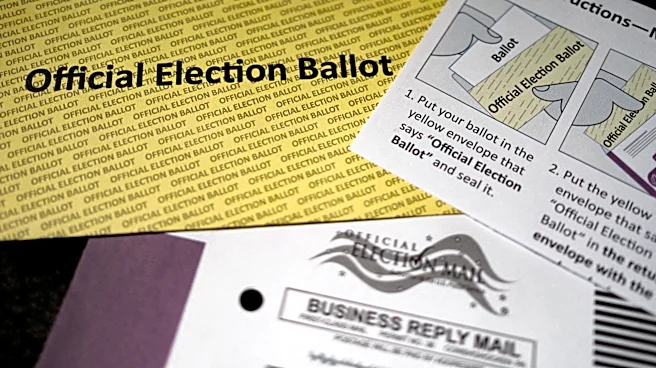
A federal appeals court has declared South Carolina's absentee voting law unconstitutional, specifically citing its violation of the 26th Amendment. The ruling, issued on August 18, focuses on the state's age-based system, which grants unrestricted access
to 'no excuse' absentee-by-mail ballots for voters aged 65 and older, while imposing requirements on younger voters. This decision overturns a 2025 ruling by U.S. District Court of South Carolina Judge Bruce Hendricks, who had previously sided with the election commission. The appeals court's nearly 30-page opinion mandates that the district court either expand the 'no excuse' absentee ballot option to all voters or eliminate the benefit entirely. The district court must now undertake further proceedings before any changes to the voting laws can be implemented.
Why It's Important?
This ruling is significant as it directly challenges the differential treatment of voters based on age, reinforcing the principle of equal access to the ballot box as enshrined in the 26th Amendment. The decision could set a precedent for other states with similar age-based absentee voting provisions, potentially leading to broader reforms in voting laws across the U.S. For South Carolina, it means a likely overhaul of its absentee voting system, which could impact voter turnout and accessibility in future elections. The case highlights the ongoing tension between states' rights to establish voting procedures and federal constitutional protections, underscoring the judiciary's role in safeguarding voting rights. The outcome will influence how states balance election integrity concerns with ensuring equitable participation for all eligible citizens.
What's Next?
The district court in South Carolina is now tasked with implementing the federal appeals court's directive. This will involve either expanding the 'no excuse' absentee ballot option to all eligible voters, regardless of age, or removing the 'no excuse' benefit for those currently receiving it. The specific timeline for these changes is not yet clear, but the district court must take up proceedings to address the ruling. This process could involve further legal arguments, public hearings, and potentially new legislative efforts by the state to comply with the court's decision. The outcome will directly affect how South Carolinians cast their ballots in upcoming elections, potentially leading to increased absentee voting access for younger demographics or a more uniform, albeit potentially more restrictive, system for all.
Beyond the Headlines
The federal appeals court's decision extends beyond the immediate impact on South Carolina's voting laws, touching upon fundamental questions of democratic participation and equality. The 26th Amendment, which lowered the voting age to 18, is central to this ruling, emphasizing that age should not be a barrier to voting access. The case also underscores the broader national debate surrounding voting rights, election security, and the role of federal courts in overseeing state election practices. It highlights how seemingly minor provisions in state laws can have significant constitutional implications, prompting a re-evaluation of voting access mechanisms. This ruling could encourage advocacy groups to challenge similar age-based restrictions in other states, potentially leading to a more standardized and equitable approach to absentee voting nationwide.