
What's Happening?
Astronomers have identified a new 'sungrazing' comet, designated C/2026 A1 (MAPS), which is expected to pass perilously close to the sun in early April. Discovered by a team of French astronomers at the AMACS1
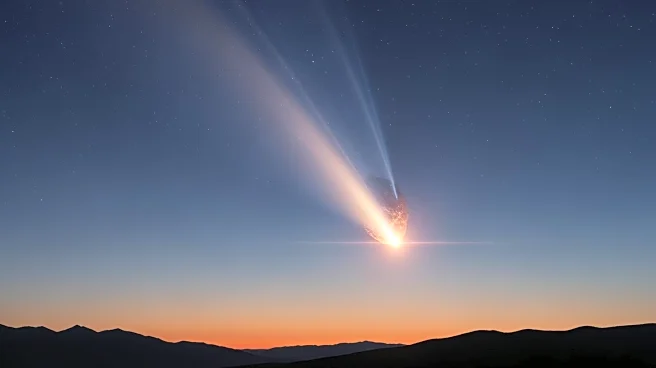
Observatory in Chile, the comet is approximately 1.5 miles wide. It belongs to the Kreutz family of comets, known for their close solar encounters. The comet will reach its closest point to the sun, or perihelion, on April 4, coming within 500,000 miles of the star. This proximity subjects the comet to intense gravitational forces and solar radiation, which could potentially destroy it. However, if it survives, C/2026 A1 may become visible to the naked eye during the day, shining brighter than the full moon.
Why It's Important?
The discovery of C/2026 A1 is significant for both scientific research and public interest. If the comet survives its close encounter with the sun, it could provide valuable data on the behavior and composition of sungrazing comets. For the public, the potential for a comet to be visible during the day is a rare astronomical event that could capture widespread attention. The comet's survival and brightness could also contribute to our understanding of the Kreutz family of comets, which are believed to be fragments of a massive comet that disintegrated centuries ago.
What's Next?
As the comet approaches its perihelion, astronomers will closely monitor its trajectory and condition. If C/2026 A1 survives, it is expected to reach its maximum brightness a few days after its closest approach to the sun. Observers in the Southern Hemisphere will have the best view, but it will also be visible in the Northern Hemisphere. The comet's behavior will be studied to gain insights into the dynamics of sungrazing comets and their interactions with solar forces.