






What's Happening?
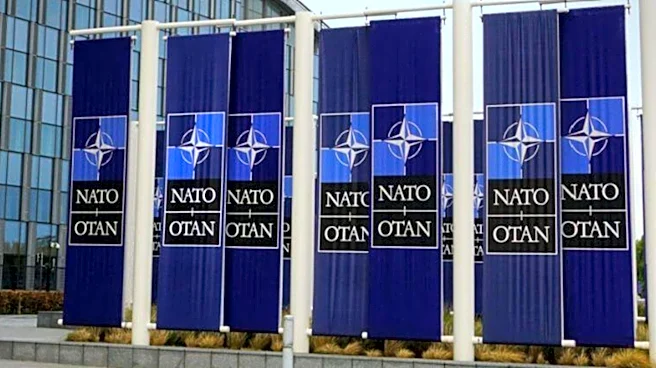
A 41-year-old senior U.S. soldier was arrested by British counter-terrorism officers near Gloucester, UK, under national security laws. The serviceman, stationed at Imjin Barracks in Gloucestershire, which houses the operational headquarters for NATO's
Allied Rapid Reaction Corps, is suspected of gathering protected data and assisting a foreign intelligence agency. Both U.S. and British law enforcement officials confirmed the arrest, stating the suspect is being held under legislation that allows detention without formal charges for up to two weeks. FBI Director Kash Patel emphasized the seriousness of the allegations, highlighting the concern for U.S. national security and its partners. Brig. Gen. Sean Stinchon of the U.S. Army Counterintelligence Command acknowledged the incident as a 'sobering reminder' of insider threats.
Why It's Important?
This arrest carries significant implications for U.S. national security and its alliances, particularly within NATO. The alleged espionage by a senior U.S. soldier, especially one stationed at a critical NATO operational headquarters, could compromise sensitive intelligence and military operations. This incident underscores the persistent threat of insider espionage and the vulnerabilities within even highly secure defense structures. For the U.S., it necessitates a rigorous review of security protocols and vetting processes for personnel with access to classified information. For NATO, it raises concerns about intelligence sharing and the integrity of its collective defense capabilities. The involvement of Russia as the alleged beneficiary of the espionage further highlights ongoing geopolitical tensions and the continuous efforts by foreign adversaries to undermine Western security interests. This event could lead to increased scrutiny and enhanced counterintelligence measures across allied forces.
What's Next?
The U.S. soldier remains in detention in the UK, with British law enforcement continuing their investigation. The legal process will likely involve formal charges, followed by a trial, which could be complex given the international nature of the alleged crime and the involvement of classified information. Both U.S. and UK authorities will collaborate closely on the investigation, potentially leading to further arrests or revelations. Internally, the U.S. Army and NATO will likely conduct their own reviews to assess the extent of any damage caused by the alleged espionage and to implement preventative measures. This incident could also prompt a broader re-evaluation of intelligence sharing protocols and counterintelligence strategies among NATO allies to mitigate future risks. The outcome of the investigation and subsequent legal proceedings will be closely watched by intelligence agencies worldwide.
Beyond the Headlines
The alleged espionage by a U.S. soldier for Russia touches upon deeper themes of loyalty, trust, and the psychological vulnerabilities that can lead individuals to betray their country. It highlights the constant, often unseen, battle waged by intelligence agencies to protect national secrets and counter foreign influence. Beyond the immediate security implications, such incidents can erode public trust in government institutions and military integrity. The case also underscores the sophisticated methods employed by foreign intelligence services to recruit and exploit individuals within adversary ranks. The 'insider threat' remains one of the most challenging aspects of national security, requiring not only robust technical safeguards but also a deep understanding of human behavior and motivation. This event serves as a stark reminder that the front lines of espionage are often within, rather than across, borders.