




What's Happening?
Missouri's Solicitor General, Lou Capozzi, representing Attorney General Catherine Hanaway and Secretary of State Denny Hoskins, has filed a federal court motion to block a Missouri Supreme Court order. The state Supreme Court had ruled that the 2025
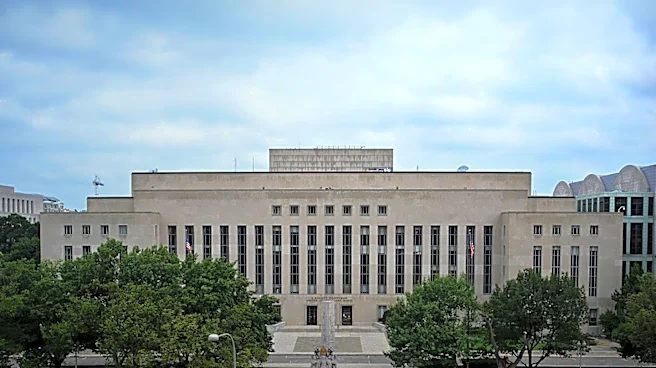
congressional map, which favors Republicans, cannot be used in the upcoming November election due to a legally sufficient petition referendum. This means the state would revert to its previous district lines. Capozzi's filing in the Eastern District of Missouri, before U.S. Chief Judge Stephen Clark (an appointee of President Trump), argues that the state Supreme Court's decision, based solely on state law, adopted a 'legal fiction' by retroactively invalidating the 2025 map used in the primary. The Attorney General's office is not defending the state Supreme Court's decision, asserting that their oath to the U.S. Constitution prevents them from defending the use of a different congressional map for the general election under these 'extraordinary and unprecedented circumstances.'
Why It's Important?
This legal challenge carries significant implications for the integrity of the electoral process and the balance of power in Missouri. The dispute centers on which congressional map will be used for the November 3 ballot, directly impacting the representation of Missouri voters. The Attorney General's unusual stance of not defending a state Supreme Court ruling in federal court highlights a deep division within the state's legal and political landscape. If the federal court intervenes and blocks the state Supreme Court's order, it could set a precedent for federal courts to override state judicial decisions on electoral matters, potentially leading to further legal battles and uncertainty in future elections. The outcome will determine whether a map favoring Republicans, drawn in 2025, or the previous district lines will be in effect, directly influencing the partisan composition of Missouri's congressional delegation.
What's Next?
U.S. Chief Judge Stephen Clark has set a noon Monday deadline for any other intervenors to file and for arguments regarding his jurisdiction. Decisions from both Judge Clark and Justice Brett Kavanaugh (who set a similar deadline for the U.S. Supreme Court appeal) could be issued as early as Monday afternoon. Tuesday marks the critical deadline for changing the November 3 ballot, as state law prohibits local election authorities and courts from adding or removing candidates or issues after this date. The U.S. Supreme Court appeal will address the broader questions raised by the plaintiffs. Chuck Hatfield, attorney for People Not Politicians, has urged Judge Clark to dismiss the case, arguing that the federal district court lacks jurisdiction and that the pending U.S. Supreme Court proceeding offers an adequate alternative forum for federal claims. He also warned that a district-court injunction directing the use of the 2025 map could create chaos for election officials, candidates, and voters.
Beyond the Headlines
The ongoing legal battle over Missouri's congressional map exposes deeper tensions regarding judicial authority, states' rights, and the politicization of redistricting. The Attorney General's decision to challenge the state's highest court in federal jurisdiction, rather than defend its ruling, suggests a strategic maneuver to achieve a desired political outcome, potentially undermining the perceived independence of the state's legal system. This situation could fuel public debate about the appropriate role of federal courts in state electoral processes and the extent to which partisan interests influence legal interpretations. Furthermore, the case highlights the persistent challenges of gerrymandering and the efforts by groups like 'People Not Politicians' to ensure fair representation through referendums. The outcome could have long-term implications for how future redistricting disputes are handled, potentially encouraging more federal interventions in state-level electoral matters.