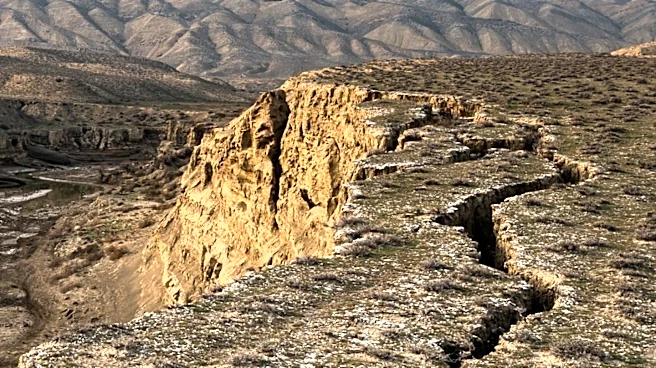










What's Happening?
A new study by the University of Bern reveals that Southern California's major fault systems, the San Andreas and San Jacinto faults, are experiencing their highest stress levels in 1,000 years. The study highlights Cajon Pass as a critical 'earthquake
gate' where a rupture could potentially spread across both fault systems. This area, northeast of Los Angeles, is geologically complex and has historically been a site where stress accumulation could lead to significant seismic events. The research, published in the Journal of Geophysical Research: Solid Earth, utilized a physics-based model to simulate 1,000 years of earthquake activity, providing insights into current stress conditions.
Why It's Important?
The findings underscore the potential for a major earthquake in Southern California, a region densely populated and economically vital. A rupture affecting both the San Andreas and San Jacinto faults could have devastating impacts, including widespread infrastructure damage and significant economic losses. The study's insights are crucial for hazard assessment and emergency preparedness, offering a clearer understanding of the seismic risks facing the region. This information is vital for policymakers, urban planners, and emergency services to develop strategies to mitigate the impact of potential earthquakes.
What's Next?
While the study does not predict when an earthquake will occur, it emphasizes the need for preparedness given the critical stress levels. Authorities and communities in Southern California may need to enhance infrastructure resilience and emergency response plans. Continued research and monitoring of fault stress levels will be essential to refine risk assessments and improve predictive models. Public awareness campaigns could also play a role in ensuring that residents are informed and prepared for potential seismic events.