






What's Happening?
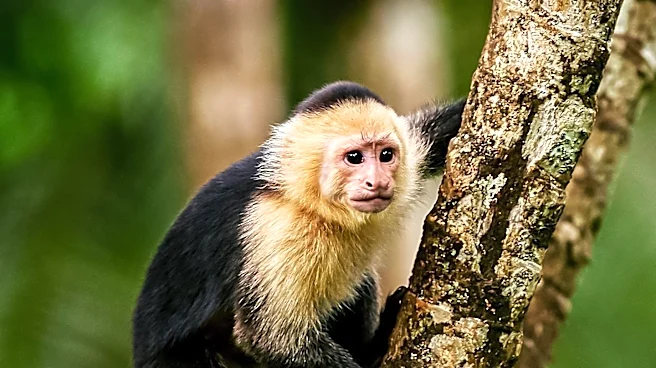
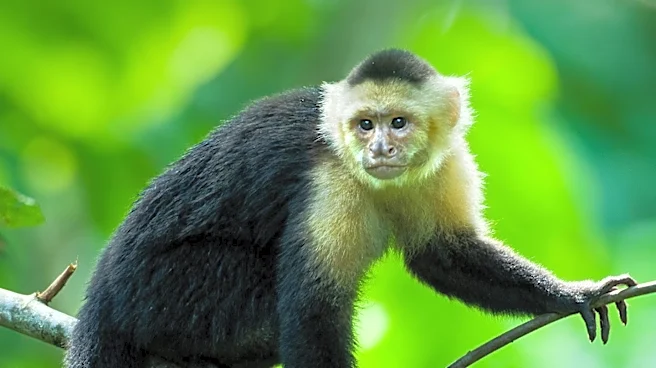
In a groundbreaking study conducted in the Taboga Forest Reserve of Costa Rica, researchers from Emory University and Georgia Institute of Technology have developed an AI system called CapuchinAI. This system uses facial recognition and real-time touchscreen
testing to study the cognitive abilities of capuchin monkeys in the wild. The AI identifies individual monkeys with 97% accuracy and presents them with learning tasks on a touchscreen, rewarding them with banana slices for correct responses. The study, published in The American Journal of Primatology, demonstrates a scalable method for cognitive testing in natural environments, allowing for the evaluation of individual differences among wild primates.
Why It's Important?
The development of CapuchinAI represents a significant advancement in the study of animal cognition, particularly in natural settings. By automating cognitive testing, researchers can gain deeper insights into the cognitive abilities and individual differences of wild primates. This method bridges the gap between laboratory and field studies, providing a more comprehensive understanding of how environmental factors influence cognitive development. The findings could have broader implications for the study of evolution and the development of AI systems that mimic natural learning processes.
What's Next?
The research team plans to expand the facial recognition model to include more capuchin monkeys and develop cognitive experiments across various domains, such as learning ability, impulse control, and memory. This will allow for a more detailed analysis of cognitive strategies and their relation to environmental adaptation and fitness. The ongoing development of CapuchinAI could lead to further innovations in the study of animal behavior and cognition, potentially influencing conservation strategies and the design of AI systems.