






What's Happening?
Japan has formally demanded that Russia release a Japanese journalist, a correspondent for the Hokkaido Shimbun newspaper, who was detained on Sakhalin on suspicion of espionage. The demand was made by Japanese Foreign Minister Toshimitsu Motegi during
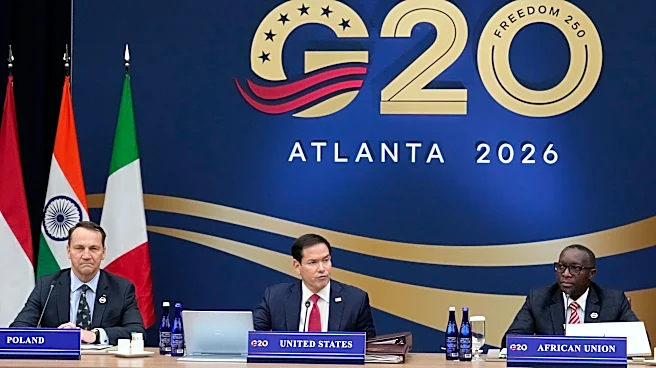
a meeting with Russian Foreign Minister Sergey Lavrov on October 30 in Atlanta, Georgia, on the sidelines of the G20 foreign ministers’ meeting. According to the Japanese Ministry of Foreign Affairs, Minister Motegi 'strongly raised the issue of his countryman’s detention and emphasized the need for his immediate release.' In addition to the journalist's detention, the Japanese diplomat also urged Moscow to work towards achieving a just and lasting peace in Ukraine. Russia has previously stated that Japan’s new sanctions allegedly hinder the prospect of a peaceful resolution to the conflict in Ukraine.
Why It's Important?
The detention of a foreign journalist on espionage charges by Russia and Japan's subsequent demand for release highlights escalating tensions between the two nations, particularly in the context of broader geopolitical shifts. This incident could strain diplomatic relations, potentially impacting ongoing discussions on various bilateral issues, including territorial disputes and economic cooperation. For journalists, such detentions raise concerns about press freedom and the safety of reporters operating in sensitive regions, potentially leading to increased self-censorship or reduced foreign media presence. The timing, during a G20 meeting, also underscores the international stage on which these diplomatic confrontations are playing out, drawing attention to the broader implications for international law and the treatment of foreign nationals. The call for peace in Ukraine by Japan further complicates the diplomatic landscape, linking the journalist's case to wider international disagreements.
What's Next?
Following Japan's demand, Russia's response will be crucial. Moscow may either proceed with legal action against the journalist, potentially leading to a trial, or engage in diplomatic negotiations for a release. The outcome will likely depend on the political leverage and diplomatic pressure exerted by Japan and its allies. This incident could lead to further diplomatic exchanges, potentially involving other international bodies or countries. Depending on Russia's actions, Japan might consider additional diplomatic or economic measures, further escalating tensions. The case will also be closely watched by international press freedom organizations, which may issue statements or campaigns advocating for the journalist's release. The broader implications for Japan-Russia relations, already strained by sanctions and geopolitical alignments, remain uncertain, with potential for either de-escalation through negotiation or further deterioration.
Beyond the Headlines
The detention of a journalist on espionage charges often transcends individual legal cases, touching upon fundamental principles of international relations, sovereignty, and freedom of the press. Such incidents can be used as diplomatic leverage, signaling a country's stance on broader geopolitical issues or as a response to perceived provocations. Ethically, it raises questions about the line between legitimate journalistic inquiry and intelligence gathering, a line that can be blurred in politically charged environments. Legally, the process and evidence presented in such cases are often scrutinized by international observers for fairness and adherence to due process. Culturally, it can fuel nationalistic sentiments and shape public perception of foreign nations. This event underscores the precarious position of journalists in an increasingly complex global landscape, where their work can inadvertently place them at the center of international disputes, highlighting the ongoing challenges to press freedom worldwide.