



What's Happening?
NASA's Curiosity Rover has successfully completed its exploration of the Martian 'boxwork terrain,' revealing new geological features that could significantly alter our understanding of Mars' history. This mission, detailed by NASA scientists, highlights
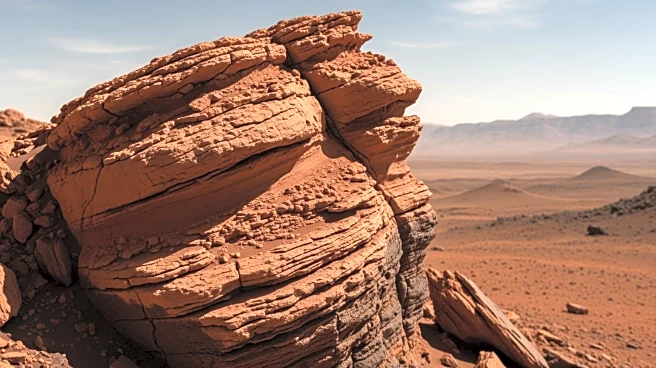
the rover's role in uncovering Mars' secrets. The rover's instruments provided unprecedented insights into a unique landscape, marking a crucial milestone in the study of Mars and its potential to support life. The exploration took place in the southern reaches of Mount Sharp, where the rover studied unusual rock formations resembling intricate patterns. These formations are believed to have formed under specific environmental conditions, offering valuable information about Mars' ancient climate and surface-shaping processes.
Why It's Important?
The discovery is significant as it provides deeper insights into Mars' sedimentary history, suggesting a more complex past than previously thought. By analyzing sediment layers and geological structures, scientists are beginning to understand how Mars' environment might have supported life billions of years ago. The findings are crucial for planning future missions, especially those aimed at human exploration. Understanding Mars' water history is vital, as water is a key ingredient for life. The data collected will serve as a foundation for future exploration, including the Perseverance rover and potential human missions.
What's Next?
The ongoing work by the Curiosity team will continue to deepen our understanding of Mars' past. The data from the boxwork terrain will be pivotal in planning future missions, including those aimed at searching for life beyond Earth. The findings will also aid in preparing for human exploration by providing crucial data about Mars' weather patterns and atmospheric conditions.