






What's Happening?
New observations from the X-Ray Imaging and Spectroscopy Mission (XRISM) satellite have resolved a nearly 50-year-old mystery surrounding gamma Cassiopeiae, the middle star in the 'W' constellation of Cassiopeia. Since 1975, this Be star has been known
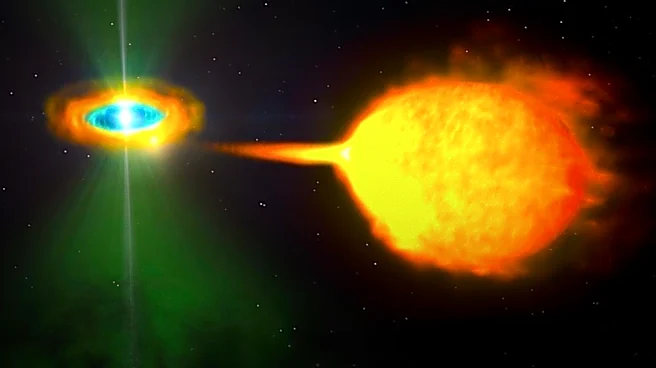
to emit X-rays far more intensely and at much higher temperatures (around 150 million degrees) than expected for its type. A team led by Yaël Nazé of the University of Liège utilized XRISM's Resolve instrument to measure the iron signatures within these X-rays. By observing gamma Cassiopeiae at three different points in its 203-day orbital cycle, they detected shifts in the iron fluorescence line that correlated with the predicted motion of an unseen companion object, rather than the star itself. The X-ray emission's velocity shift was measured at 148 kilometers per second, while the Be star's own velocity changed by only seven kilometers per second in the opposite direction, definitively pointing to the companion as the source of the anomalous X-rays.
Why It's Important?
This discovery fundamentally alters our understanding of gamma Cassiopeiae and similar 'gamma Cas analogues,' a class of early-type Be stars. It confirms that the extreme X-ray emissions are not intrinsic to the Be star's magnetic activity, as one leading theory suggested, but originate from an interaction with a companion object. This finding has significant implications for stellar astrophysics, particularly in the study of binary star systems and the evolution of massive stars. It helps to close a long-standing gap in population models, which predict a higher fraction of Be stars with white dwarf companions than previously identified. Understanding the mechanism behind these powerful X-ray emissions can shed light on accretion processes onto compact objects like white dwarfs, and how these interactions influence the surrounding stellar environment. This research also validates the capabilities of advanced X-ray observatories like XRISM in resolving complex astrophysical phenomena.
What's Next?
The next steps in this research will involve further observations and theoretical modeling to fully characterize the unseen companion. While the evidence strongly points to an accreting white dwarf, its specific properties, such as its mass, magnetic field, and accretion rate, remain to be precisely measured. Scientists will aim to develop hydrodynamical simulations specifically for Be star and white dwarf pairs, incorporating radiative transfer to better understand the physical processes at play. Additionally, researchers will investigate why these systems maintain X-ray emissions even when the disc feeding the white dwarf largely dissipates, a phenomenon still requiring explanation. The discrepancy between observed populations of gamma Cas analogues and theoretical models regarding the mass of their Be star components will also be a focus of future study, potentially leading to refinements in stellar evolution models.
Beyond the Headlines
This breakthrough extends beyond merely identifying the source of X-rays; it represents a significant step in understanding the complex dynamics within binary star systems. The confirmation of a white dwarf companion as the X-ray emitter in gamma Cassiopeiae opens new avenues for studying accretion physics in environments where a massive, fast-spinning star interacts with a compact object. It highlights the intricate interplay of gravitational forces, magnetic fields, and stellar winds that can lead to extreme energetic phenomena. Furthermore, this discovery underscores the ongoing challenge of detecting and characterizing 'dark' companions in binary systems, which can profoundly influence the evolution and observable properties of their primary stars. The resolution of this long-standing puzzle exemplifies how advanced observational techniques, combined with theoretical predictions, continue to refine our cosmic understanding, often revealing unexpected complexities in seemingly familiar celestial objects.