
What's Happening?
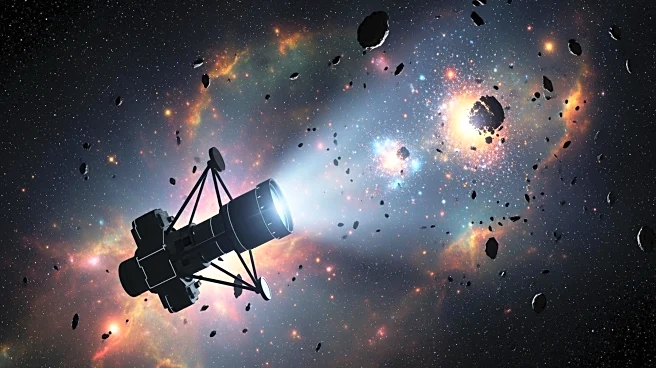
The Hubble Space Telescope has captured images of debris from two cosmic collisions near the star Fomalhaut, solving a decades-old mystery. Initially thought to be a planet, a bright spot observed near Fomalhaut was
revealed to be a dust cloud from colliding space rocks. These collisions, involving rocks at least 37 miles wide, are rare, typically occurring once every 100,000 years. However, two such events have been observed within 20 years, suggesting they may be more frequent than previously believed. The findings, published in the journal Science, highlight the importance of these collisions in understanding planetary formation.
Why It's Important?
These observations are crucial for understanding the processes that lead to planet formation. The ability to capture such events provides a 'toddler picture' of our solar system, offering insights into the early stages of planetary development. The discovery challenges existing theories about the frequency of such collisions, potentially altering our understanding of planetary system dynamics. This research could impact future studies of exoplanets and the search for habitable worlds, as it provides a clearer picture of the conditions necessary for planet formation.
What's Next?
Researchers plan to continue monitoring the new dust cloud to observe its evolution and eventual disintegration. This ongoing study will help scientists understand the lifecycle of debris clouds and their role in planetary system development. The proximity of the Fomalhaut system, just 25 light years from Earth, allows for detailed observation and analysis, providing valuable data for future research. These findings may also inform the design of future space missions aimed at detecting and studying exoplanets.