


What's Happening?
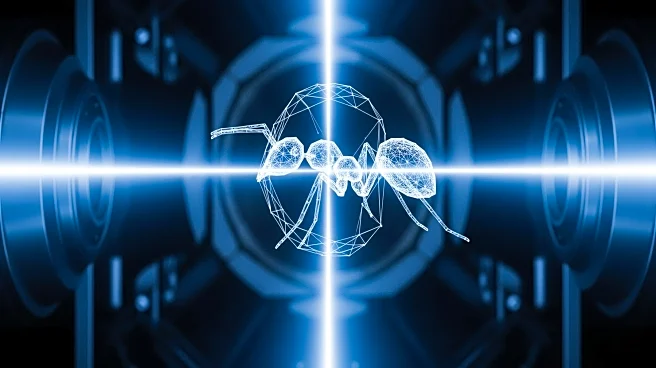
A team of researchers, led by Evan Economo and Thomas van de Kamp, has utilized a synchrotron particle accelerator to create detailed 3D models of 800 ant species. This innovative approach combines X-ray imaging, robotics, and artificial intelligence
to rapidly scan and digitize ant specimens. The project, known as Antscan, significantly reduces the time required to produce 3D models compared to traditional methods. The resulting digital models are publicly available and can be used for scientific research, education, and entertainment. This advancement in imaging technology allows for a more comprehensive understanding of ant morphology and biodiversity.
Why It's Important?
The development of high-throughput 3D imaging techniques has broad implications for biodiversity research and conservation. By providing detailed digital models of ant species, researchers can better study their physical traits and evolutionary relationships. This technology also facilitates the creation of digital libraries, which can be used in various fields, from scientific research to education and media production. The ability to quickly and accurately digitize biological specimens could revolutionize how biodiversity is documented and studied, leading to new insights into species diversity and ecosystem dynamics.
What's Next?
The success of the Antscan project may inspire similar initiatives for other organisms, expanding the scope of digital biodiversity archives. Researchers plan to continue expanding the database by scanning additional specimens and applying AI techniques to new biological datasets. The integration of these digital models with other data types, such as genetic information, could enhance our understanding of the connections between physical traits and genetic variation. As the technology advances, it may also be used to train machine learning systems for field studies, further enhancing biodiversity research capabilities.