








What's Happening?
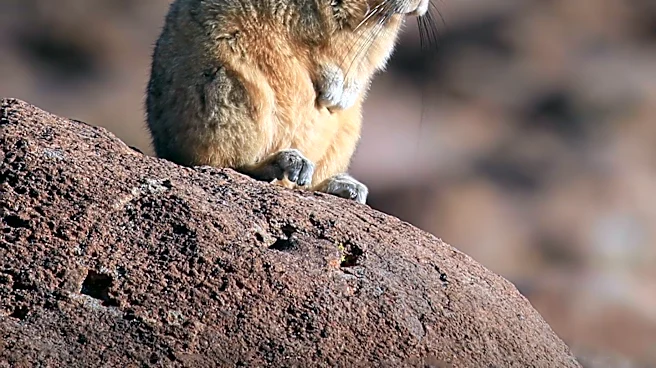
Eight years of dedicated research on the Wolffsohn's viscacha, a largely unknown rodent species native to Patagonia, has significantly advanced understanding of its ecology and behavior. Led by ecologists Lucas Hormachea and Morgan Pendaries, the project
involved studying 66 sites in remote Patagonian mountains, often under extreme conditions. The detailed information gathered has led to the species' official conservation status being upgraded from 'Data Deficient' to 'Endangered' on Argentina's Red List, with data also being used to re-evaluate its status on the IUCN global Red List. Researchers discovered new colonies, documented population declines, and found that the species is more nocturnal than previously thought. Threats identified include invasive European rabbits, wild dogs, human disturbance from mountaineering, and the impacts of climate change in the Patagonian Andes.
Why It's Important?
This research is crucial for global biodiversity conservation efforts, particularly for species that are poorly understood. For the U.S. and international conservation communities, the reclassification of Wolffsohn's viscacha to 'Endangered' highlights the urgent need for targeted conservation strategies and funding. It underscores the importance of long-term field research in remote areas to identify and protect vulnerable species before they face irreversible decline. The findings also contribute to a broader understanding of how climate change, invasive species, and human activities impact fragile ecosystems, providing valuable data for conservation models and policy development worldwide. This case demonstrates that even seemingly obscure species play a vital role in ecosystem health, and their protection is essential for maintaining biodiversity.
What's Next?
Following the reclassification to 'Endangered,' efforts are underway to secure legal protection for the Wolffsohn's viscacha. A legislative proposal is being developed to declare the species a 'Natural Heritage Monument' in Argentina's Santa Cruz province, which would grant it legal protection under Argentina's National Parks Law. This move aims to ensure the species' long-term survival by establishing protected areas and implementing conservation measures. Further research will likely focus on mitigating identified threats, such as managing invasive species, controlling wild dog populations, and assessing the specific impacts of climate change. Public awareness campaigns may also be launched to educate local communities and visitors about the viscacha's plight and the importance of its conservation.
Beyond the Headlines
Beyond the immediate conservation actions, the story of the Wolffsohn's viscacha highlights the profound challenges and rewards of scientific exploration in remote environments. The extreme conditions faced by researchers underscore the dedication required to uncover the secrets of the natural world. This research also brings to light the concept of 'convergent evolution,' where unrelated species (like viscachas and rabbits) develop similar physical traits due to similar environmental pressures, offering insights into evolutionary biology. The shift in conservation status from 'Data Deficient' to 'Endangered' serves as a powerful reminder that a lack of data often masks significant threats, emphasizing the need for proactive research rather than waiting for visible signs of decline. Ultimately, the protection of such unique species contributes to the overall health and resilience of global ecosystems, benefiting all life on Earth.