





What's Happening?
Researchers from the Institute of Geology and Geophysics of the Chinese Academy of Sciences have developed a new three-dimensional model to better understand the magma generation beneath supervolcanoes like Yellowstone. Traditionally, it was believed
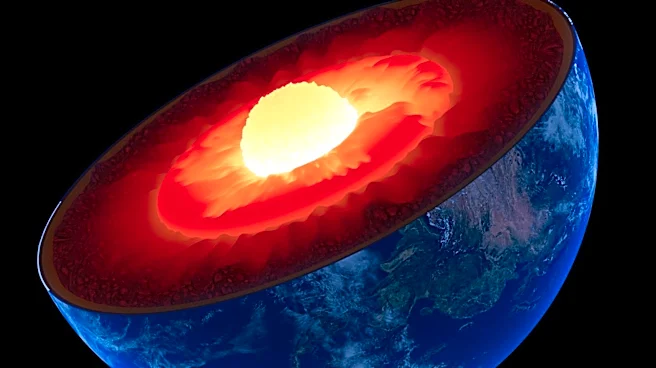
that supervolcanoes contained large chambers of liquid magma. However, new evidence suggests that magma is distributed across extensive regions of partially molten rock, known as 'magma mush' systems. These systems are spread throughout the lithosphere, challenging previous models. The study indicates that magma feeding supervolcanoes originates from the upper asthenosphere, with a 'mantle wind' transporting hot material towards Yellowstone. This mantle wind is a result of the subduction of the Farallon Plate, creating conditions for decompression melting and magma production.
Why It's Important?
Understanding the magma source and behavior of supervolcanoes like Yellowstone is crucial due to their potential to cause massive eruptions that can dramatically affect climate, ecosystems, and human societies. The new model provides insights into the formation and sustainability of large magmatic systems, which are essential for predicting future volcanic activity. This research could lead to improved monitoring and risk assessment strategies for supervolcanoes, potentially mitigating the impact of future eruptions. The findings also challenge the long-standing belief that Yellowstone is fueled by a deep mantle plume, offering a new perspective on the geological processes shaping the region.
What's Next?
The study opens avenues for further research into the dynamics of supervolcanoes and their magmatic systems. Scientists may focus on refining the model and applying it to other supervolcanoes worldwide to test its validity. Additionally, the findings could influence future geological surveys and monitoring efforts at Yellowstone and similar sites. Understanding the role of the mantle wind and its impact on magma generation could lead to new methods for predicting volcanic activity, potentially improving early warning systems and reducing the risks associated with supereruptions.