
What's Happening?
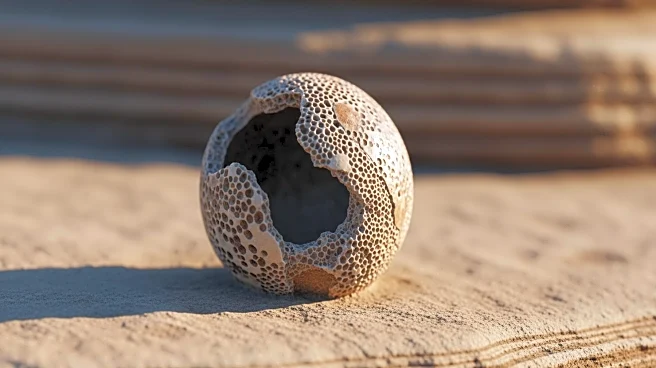
A team of geologists and paleontologists has introduced a novel method to accurately date fossil-bearing rocks by analyzing fossilized dinosaur eggshells. This technique, led by Dr. Ryan Tucker from Stellenbosch
University, offers a reliable alternative to traditional methods that rely on surrounding minerals, which are not always present. The research, published in Communications Earth & Environment, utilizes uranium-lead (U-Pb) dating combined with elemental mapping to measure uranium and lead in the calcite structure of eggshells. These elements decay at known rates, providing a 'built-in clock' to determine when the eggs were buried. The method was tested on dinosaur eggshells from Utah and Mongolia, achieving an accuracy of about five percent compared to ages determined from volcanic ash layers. This breakthrough allows for direct dating of fossil sites where volcanic layers are absent, a significant advancement in paleontology.
Why It's Important?
This development is crucial for paleontology as it provides a new tool for dating fossil sites, especially those lacking volcanic layers. Accurate dating is essential for understanding the evolution and interaction of ancient species and ecosystems. The ability to directly date fossils, such as dinosaur eggshells, bridges a gap between biology and Earth science, offering insights into dinosaur evolution that were previously unattainable. This method enhances the precision of age estimates, which is vital for constructing accurate timelines of Earth's history and the development of life. The technique's success in Mongolia, where it established the first direct age for a site with dinosaur eggs and nests, underscores its potential to revolutionize fossil dating worldwide.
What's Next?
The new dating technique is expected to be applied to more fossil sites globally, providing more accurate timelines for paleontological research. As researchers adopt this method, it could lead to revisions of existing fossil records and timelines, offering new insights into the history of life on Earth. The collaboration between international institutions, including the North Carolina Museum of Natural Sciences and the Mongolian Academy of Sciences, suggests that further studies and fieldwork will continue to refine and expand the application of this technique. The support from organizations like the National Geographic Society and the National Science Foundation indicates ongoing interest and investment in advancing paleontological research.