





What's Happening?
President Trump has recently expressed interest in making Venezuela the 51st U.S. state, a move that has been met with near-silence from the Venezuelan government. This interest was communicated through a Truth Social post featuring a map of Venezuela filled
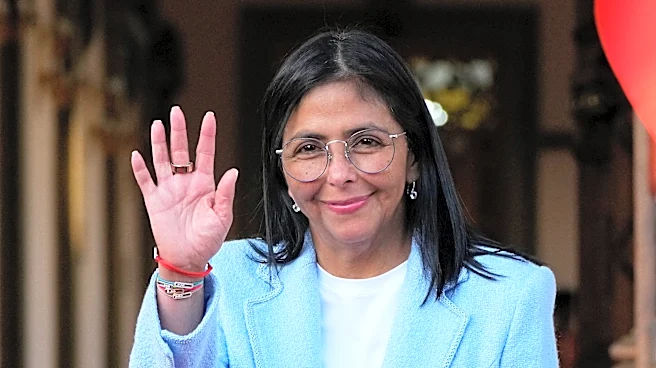
with the U.S. flag. Historically, such statements have been met with strong opposition from Venezuelan officials, but the current acting President, Delcy Rodríguez, has opted for a more reserved response. Rodríguez stated that Venezuela has no plans to become a U.S. state and emphasized the country's sovereignty and independence. This muted response is seen as a strategic move by Rodríguez, who is balancing internal and external political pressures following a U.S. military intervention in Caracas and the ousting of former President Nicolás Maduro.
Why It's Important?
The proposal by President Trump to incorporate Venezuela as a U.S. state is significant as it highlights the ongoing geopolitical tensions between the U.S. and Venezuela. The muted response from the Venezuelan government suggests a shift in strategy, possibly influenced by the need to maintain diplomatic relations with the U.S. amidst economic challenges. This development could impact U.S.-Venezuela relations, particularly in terms of economic sanctions and international investments in Venezuela's oil sector. The situation also reflects the broader implications of U.S. foreign policy in Latin America and the potential for shifts in regional alliances.
What's Next?
The future of U.S.-Venezuela relations remains uncertain, with potential developments hinging on the actions of both governments. The Trump administration's phased plan to stabilize Venezuela could lead to further cooperation or conflict, depending on how both parties navigate the political landscape. The response from Venezuelan citizens and political groups will also play a crucial role in shaping the country's stance towards the U.S. and its internal political dynamics.
Beyond the Headlines
The situation underscores the complex interplay between national sovereignty and international diplomacy. Venezuela's strategic response to President Trump's proposal may indicate a pragmatic approach to foreign relations, prioritizing economic recovery and political stability over ideological confrontations. This could lead to a redefinition of Chavismo, the political ideology associated with former President Hugo Chávez, as it adapts to new geopolitical realities.