



What's Happening?
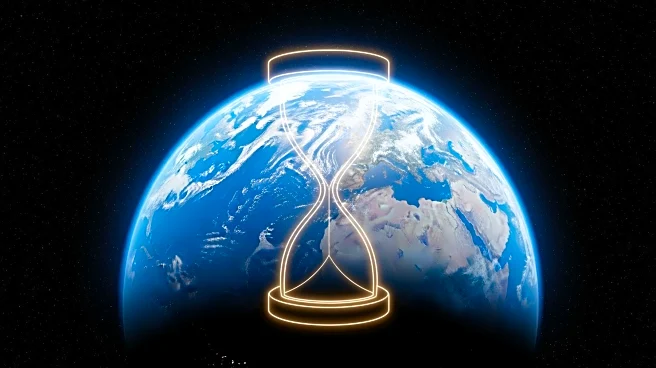
New research indicates that Earth's rotation is slowing at a rate not seen in 3.6 million years, primarily due to climate change. Rising sea levels from melting ice sheets are redistributing Earth's mass, causing the planet to spin more slowly and lengthening
the day by approximately 1.33 milliseconds per century. This phenomenon, attributed to human-induced climate change, poses challenges for precise space navigation and other scientific applications that rely on accurate measurements of Earth's rotation.
Why It's Important?
The findings highlight the far-reaching impacts of climate change beyond immediate environmental effects, influencing fundamental planetary dynamics. The gradual increase in day length, while seemingly minor, could have significant implications for scientific fields that depend on precise timekeeping and rotational data. This research underscores the interconnectedness of climate systems and planetary mechanics, emphasizing the need for comprehensive climate action to mitigate unforeseen consequences.
What's Next?
Researchers anticipate that climate change will continue to influence Earth's rotation, potentially surpassing the effects of the Moon's gravitational pull by the end of the century. Ongoing studies will focus on refining models to predict future changes and their implications. The scientific community may increase efforts to develop adaptive technologies and strategies to address the challenges posed by these changes in Earth's rotation.