



What's Happening?
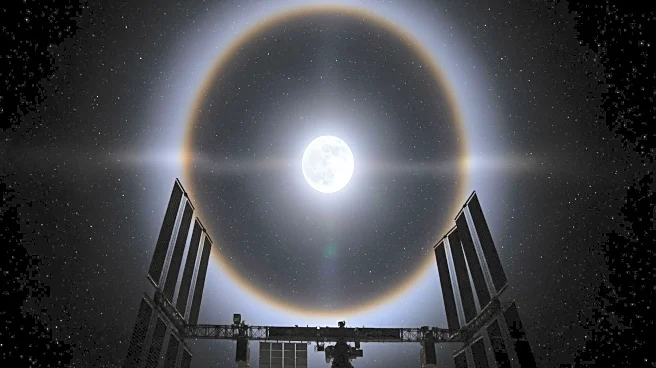
An astronaut aboard the International Space Station (ISS) recently captured a stunning image of a rare lunar halo, an optical phenomenon that occurs when moonlight refracts through ice crystals in Earth's atmosphere. This image, taken above the Indian
Ocean, showcases a delicate arc of light encircling the Moon. Lunar halos are typically formed by hexagonal ice crystals in the mesosphere, a high-altitude layer of Earth's atmosphere. The ISS's unique vantage point allows astronauts to observe such phenomena without the interference of weather systems, providing clear insights into atmospheric optics.
Why It's Important?
The capture of a lunar halo from space provides valuable data for scientists studying atmospheric conditions and optical phenomena. Understanding how light interacts with ice crystals at high altitudes can enhance knowledge of Earth's atmospheric processes. This information is crucial for improving weather prediction models and understanding climate dynamics. Additionally, such observations contribute to the broader field of atmospheric science, offering insights into the behavior of ice crystals and their role in atmospheric phenomena.