



What's Happening?
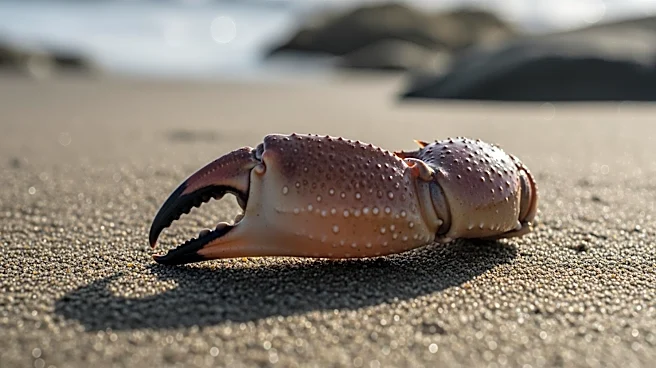
Researchers have traced the sideways walking behavior of true crabs back to a single evolutionary event approximately 200 million years ago. This discovery was made through a comprehensive study involving 50 species of crabs, where 35 were found to primarily
move sideways. The study, published in eLife, suggests that this unique locomotion style evolved once in a forward-walking ancestor of the Eubrachyura group and has been preserved throughout the evolution of true crabs. The sideways movement is believed to provide a survival advantage by allowing crabs to evade predators more effectively. The research highlights that while body shapes in crabs have evolved multiple times, behavioral changes like sideways walking are rare.
Why It's Important?
The study's findings are significant as they provide insights into the evolutionary success of true crabs, which have diversified into over 7,900 species across various habitats. The ability to move sideways may have contributed to their ecological success by offering a strategic advantage in predator evasion. This research enhances the understanding of how specific locomotion traits can influence the survival and diversification of species. It also underscores the role of environmental changes, such as those following the Triassic-Jurassic extinction, in creating new ecological opportunities that facilitated the diversification of true crabs.
What's Next?
Future research may focus on further analyzing the relationship between environmental changes and evolutionary innovations in crabs. This could involve fossil-informed timelines and performance tests to link sideways movement to adaptive advantages. Such studies could provide deeper insights into how evolutionary traits develop and persist, offering broader implications for understanding animal movement and adaptation.
Beyond the Headlines
The study also raises questions about the constraints of evolutionary innovations, as sideways walking, while advantageous, may interfere with other behaviors like burrowing and mating. This highlights the complex interplay between evolutionary adaptations and ecological contexts, suggesting that while certain traits can open new adaptive opportunities, they remain influenced by phylogenetic history.