
What's Happening?
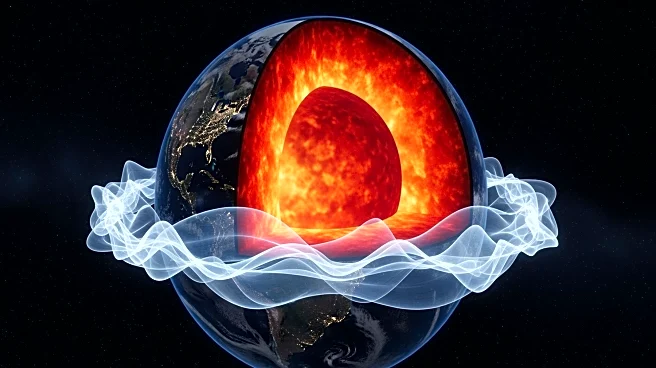
A recent study published in Nature Communications reveals that Earth's core may contain up to 45 oceans' worth of hydrogen. Researchers used laser-heated diamond anvil cells to simulate the extreme conditions
of the Earth's core, allowing them to analyze core-like iron samples and hydrous silicate glass. This method enabled the identification of silicon, oxygen, and hydrogen in the samples, suggesting a significant hydrogen presence. The study challenges previous theories that Earth's water was primarily delivered by comets, proposing instead that hydrogen was present during Earth's early accretion.
Why It's Important?
The discovery of a substantial hydrogen reservoir in Earth's core has significant implications for understanding the planet's formation and water acquisition. It suggests that Earth's water may have been acquired in situ during its formation, rather than through cometary delivery. This insight could reshape theories about planetary formation and the distribution of water in the solar system. Additionally, understanding the hydrogen content in the core could influence models of Earth's geodynamics and the behavior of its magnetic field.