



What's Happening?
Spanish Oscar-winning actor Javier Bardem has publicly supported a petition calling for the removal of pop singer Pink as a UNICEF ambassador. The petition, initiated by 'Swifties Against Genocide,' has garnered over 192,000 signatures and argues that
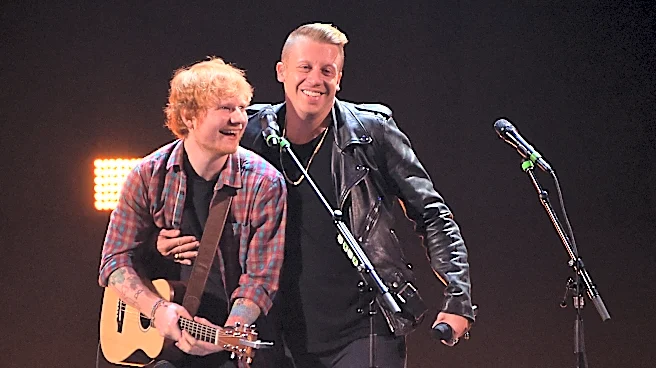
UNICEF ambassadors should maintain strict neutrality and compassion, particularly towards Palestinian children affected by the Israel-Gaza conflict. Bardem shared the petition on his Instagram account, aligning with his past vocal support for Palestinians. This development follows Pink's criticism of rapper Macklemore's pro-Palestinian comments and imagery during an Ed Sheeran tour, which led to Macklemore's removal from the tour. Pink, whose real name is Alecia Beth Moore-Hart, cited her decade-long work as a UNICEF ambassador in an Instagram post, stating her grief for children on both sides of the conflict and expressing concern over Macklemore's remarks, particularly his address to Jewish audience members. She clarified that her concern was not about Macklemore's 'Free Palestine' stance but his assertion that criticism of Israel was not a criticism of Jewish people.
Why It's Important?
This situation highlights the increasing pressure on public figures and international organizations to navigate the complexities of the Israel-Gaza conflict. For UNICEF, an organization dedicated to children's welfare globally, the controversy raises questions about the role and responsibilities of its ambassadors, particularly regarding political neutrality. The petition's significant number of signatures indicates a strong public sentiment demanding that humanitarian representatives uphold impartiality. Bardem's involvement, given his past experience with backlash for comments on the conflict, underscores the deeply divisive nature of the issue. Pink's defense of her comments, rooted in her identity as a Jewish woman and her humanitarian work, illustrates the personal and professional challenges faced by celebrities when engaging with such sensitive geopolitical matters. The debate also reflects broader societal tensions regarding freedom of speech, the interpretation of criticism against Israel, and the impact of celebrity endorsements on public discourse.
What's Next?
The petition calling for Pink's removal as a UNICEF ambassador continues to gather signatures, increasing pressure on the organization. UNICEF has not yet issued a public statement regarding the petition or Bardem's support, though UN officials have previously stated that ambassadors' personal views do not necessarily reflect those of UNICEF. However, UNICEF has removed ambassadors in the past for political conduct, as seen with Boris Becker in 1987. The ongoing public debate and the potential for further celebrity involvement could force UNICEF to re-evaluate its guidelines for ambassador conduct in politically charged situations. Macklemore's upcoming 'Free Palestine' tour, with proceeds benefiting organizations supporting Palestinians, is likely to further fuel discussions and potentially draw more attention to the petition and the broader conflict.
Beyond the Headlines
The controversy extends beyond the immediate calls for Pink's removal, touching upon the ethical obligations of public figures in humanitarian roles. It raises questions about whether ambassadors for neutral organizations like UNICEF can effectively separate their personal political views from their official duties, especially when those views become public and contentious. The incident also underscores the challenges of maintaining a unified message of compassion in highly polarized conflicts, where even attempts at neutrality can be perceived as taking a side. The use of social media by celebrities to express political opinions, and the subsequent public reactions, demonstrate the amplified impact of such statements in the digital age. This event could lead to a re-evaluation of how international humanitarian organizations select and manage their public representatives, potentially leading to stricter guidelines on political engagement to safeguard their perceived impartiality.