
What's Happening?
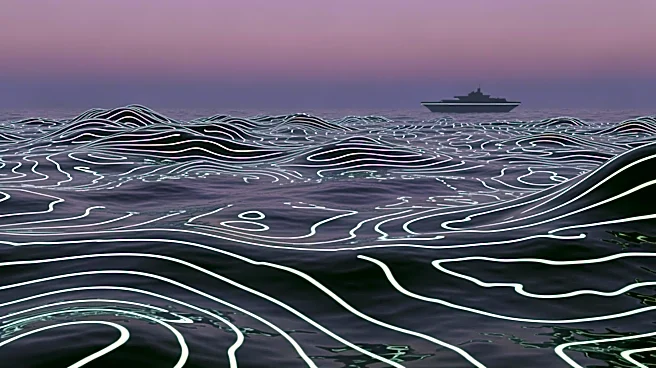
Researchers from MIT and the Woods Hole Oceanographic Institution have created a new model that simulates wave formation and evolution under various planetary conditions. This model considers differences
in gravity, liquid composition, and atmospheric density, allowing scientists to explore wave dynamics beyond Earth-like oceans. The study, published in the Journal of Geophysical Research: Planets, highlights how wave behavior can vary dramatically across the solar system. The model provides insights into alien oceans, such as those on Saturn's moon Titan, where seas of liquid hydrocarbons present unique wave dynamics due to lower gravity and thicker atmospheres.
Why It's Important?
This development is significant as it expands the understanding of wave dynamics beyond Earth, offering a framework for future space missions to planets and moons with liquid surfaces. The model's ability to predict wave behavior in alien environments can aid in designing probes and instruments for missions to places like Titan. Understanding these dynamics is crucial for planning exploration strategies and ensuring the safety and effectiveness of equipment used in extraterrestrial environments. The research also provides a new perspective on geological and climatic processes on other planets, potentially explaining features like Titan's unique coastlines.
What's Next?
The model's insights could influence the design of future space missions, particularly those targeting Titan and other celestial bodies with liquid surfaces. Engineers may need to consider the model's predictions when developing landers or floating platforms to withstand the forces of alien waves. Additionally, the research may prompt further studies into the geological processes on Titan, such as sediment transport and shoreline erosion, which could reshape understanding of its landscape. The findings may also inspire similar models for other planetary bodies, enhancing the overall knowledge of extraterrestrial environments.