









What's Happening?
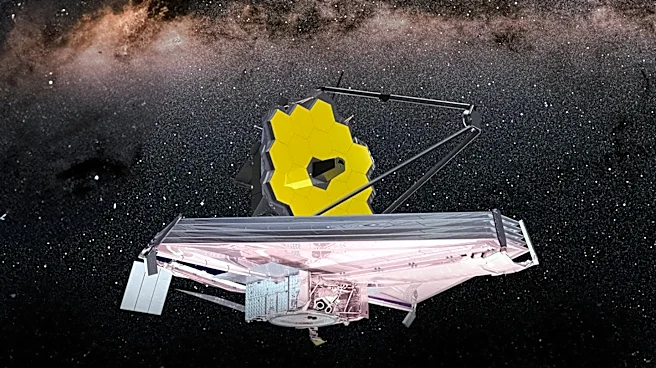
Astronomers have identified the first of an estimated 10,000 missing stellar-mass black holes in the Omega Centauri globular cluster. This discovery was made possible through the combined efforts of the Hubble and James Webb Space Telescopes. The black hole was detected
by observing a star orbiting an unseen massive object, which was confirmed to be a black hole due to its mass being too large for a neutron star. The research, led by Matthew Whitaker from the University of Utah, utilized over 20 years of Hubble data and recent observations from the James Webb Space Telescope. Omega Centauri, the largest globular cluster in the Milky Way, is believed to be the remnant core of a dwarf galaxy, containing about 10 million stars.
Why It's Important?
The discovery of this black hole is significant as it provides insights into the population of black holes within globular clusters, which are key environments for understanding the formation and dynamics of black holes. This finding also contributes to the study of gravitational waves, as these clusters are thought to be sites where black hole mergers occur, producing detectable gravitational waves. Understanding the distribution and characteristics of black holes in such clusters can enhance our interpretation of gravitational wave data and improve our knowledge of stellar evolution and black hole formation.
What's Next?
The research team plans to continue using data from the Hubble and James Webb Space Telescopes to identify more stellar-mass black holes in Omega Centauri. Additionally, the upcoming launch of NASA's Nancy Grace Roman Space Telescope is expected to aid in the discovery of black hole binary systems within the Milky Way, thanks to its wide field of view and high-resolution imaging capabilities. These efforts will further our understanding of black hole populations and their role in the dynamics of globular clusters.