
What's Happening?
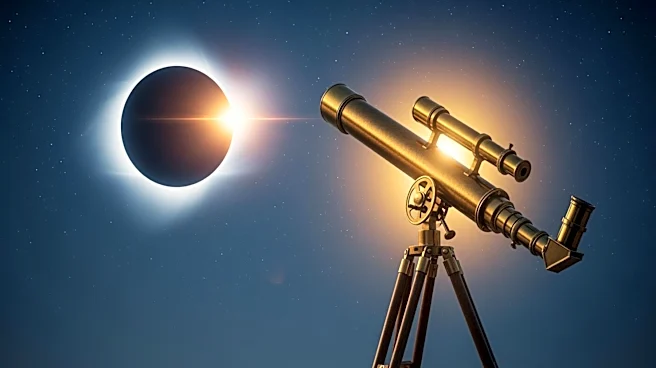
On May 29, 1919, a total solar eclipse provided the perfect opportunity to test Albert Einstein's theory of general relativity. English physicist Sir Arthur Eddington led an expedition to the island of Principe,
off the west coast of Africa, to observe the eclipse. The goal was to measure the bending of light, known as gravitational lensing, predicted by Einstein's theory. During the eclipse, Eddington and his team photographed the stars near the Sun, particularly those in the Hyades cluster. The measurements showed a deflection in the position of the stars, confirming the theory. This experiment was crucial in proving the concept of gravitational lensing and catapulted Einstein to international fame.
Why It's Important?
The successful confirmation of Einstein's theory of general relativity marked a pivotal moment in the history of science. It not only validated a fundamental aspect of modern physics but also demonstrated the power of scientific inquiry and experimentation. The findings had profound implications for our understanding of the universe, influencing fields such as cosmology and astrophysics. The experiment's success also highlighted the importance of international scientific collaboration, as it took place shortly after World War I, symbolizing a return to peaceful scientific pursuits.