







What's Happening?
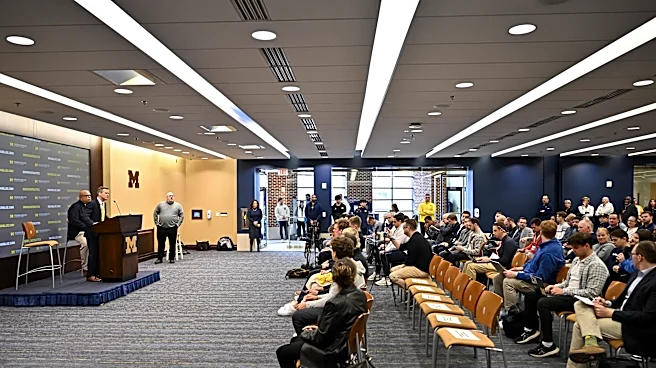
The University of Michigan Library is hosting a workshop titled 'When AI Gets It Wrong: Learning Generative AI Through Its Mistakes.' Led by Kwok-leong Tang, managing director of the Digital China Initiative and a lecturer at Harvard University, the workshop focuses
on understanding why generative AI tools make errors, particularly with historical East Asian sources. The goal is to equip participants with the knowledge to discern when to trust AI outputs and when to be skeptical. The hands-on session will involve running a small AI model on laptops to observe how it processes text, chooses words, and can confidently produce incorrect information. Participants will learn to differentiate between errors caused by the model's limitations and those resulting from insufficient input, and practice methods for testing AI answers against reliable sources.
Why It's Important?
This workshop is crucial for U.S. academic and professional communities as generative AI becomes more prevalent in research, education, and various industries. Understanding the limitations and potential for error in AI tools is vital for maintaining academic integrity and ensuring the reliability of information. For students and researchers, particularly those working with specialized or historical datasets, the ability to critically evaluate AI-generated content prevents the propagation of misinformation. For businesses and government agencies, recognizing AI's fallibility is essential for making informed decisions and avoiding costly mistakes. The workshop's focus on practical evaluation techniques empowers users to leverage AI effectively while mitigating risks, fostering a more discerning and responsible approach to AI adoption across diverse sectors.
What's Next?
The insights gained from workshops like this will likely influence how educational institutions and organizations integrate generative AI into their curricula and workflows. There will be an increased emphasis on AI literacy, critical thinking, and data verification skills for students and professionals. Universities may develop more courses or modules dedicated to understanding AI's internal workings and its ethical implications. For AI developers, feedback from such workshops could highlight areas for improvement in model training, particularly concerning specialized datasets and cultural nuances. The ongoing challenge will be to balance the benefits of AI's efficiency with the necessity of human oversight and critical evaluation, ensuring that AI tools serve as aids rather than unquestioned authorities, especially in fields requiring high accuracy and contextual understanding.
Beyond the Headlines
The workshop's focus on AI's mistakes, particularly with historical East Asian sources, highlights a broader issue of algorithmic bias and cultural representation in AI models. Many AI systems are trained on datasets that may be predominantly Western-centric, leading to inaccuracies or misinterpretations when applied to other cultural or historical contexts. This raises ethical questions about the inclusivity and fairness of AI technologies. The ability of AI to 'sound certain and still be wrong' also underscores the psychological impact of AI on human trust and decision-making, emphasizing the need for transparency and explainability in AI systems. Addressing these biases and limitations is not just a technical challenge but a societal one, requiring interdisciplinary collaboration to develop AI that is more globally aware, equitable, and reliable across diverse knowledge domains.