






What's Happening?
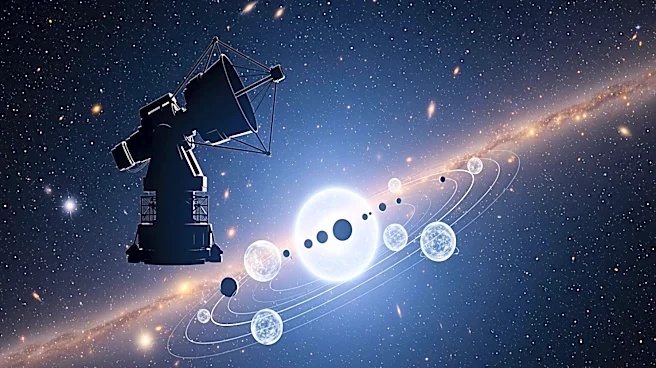
The interstellar comet 3I/ATLAS, only the third such object detected, has been found to contain water with an unusually high level of deuterium, a heavy form of hydrogen. This discovery, made using the Atacama Large Millimeter/submillimeter Array (ALMA)
in Chile, suggests that the comet originated in a much colder environment than our solar system. The deuterium levels in 3I/ATLAS are significantly higher than those found in comets from our solar system or in Earth's oceans. This finding provides a rare glimpse into the conditions of other planetary systems, indicating that the comet's birthplace was far colder than the regions that formed the planets and icy bodies in our solar system.
Why It's Important?
The discovery of 3I/ATLAS's unique chemical composition offers valuable insights into the diversity of planetary systems across the galaxy. By analyzing the deuterium levels, researchers can infer the environmental conditions of the comet's origin, which differ significantly from those of our solar system. This information enhances our understanding of how planetary systems form and evolve, potentially reshaping theories about planet and comet formation. The study of interstellar objects like 3I/ATLAS allows scientists to compare the birth conditions of different planetary systems, providing a broader perspective on the potential for habitable worlds beyond our solar system.
What's Next?
Future observations and discoveries of interstellar objects will continue to expand our understanding of planetary system formation. The Vera C. Rubin Observatory in Chile is expected to detect more interstellar objects, which will help determine whether 3I/ATLAS is an outlier or if similar chemical compositions are common among such comets. These findings could lead to new questions and theories about the formation and evolution of planetary systems, as well as the conditions that might support life elsewhere in the universe.