
What's Happening?
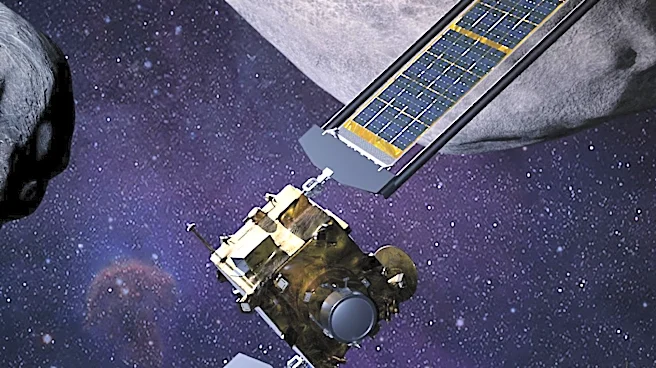
On April 13, 2029, asteroid 99942 Apophis will pass Earth at a distance of approximately 32,000 kilometers, closer than geostationary satellites. NASA's OSIRIS-APEX spacecraft will observe the asteroid during this close approach to study the effects of Earth's
gravity on its orbit and rotation. The encounter is expected to alter Apophis' orbit and may cause surface changes such as seismic shaking or landslides. OSIRIS-APEX will not be at the closest point during the flyby but will follow the asteroid to conduct detailed studies afterward.
Why It's Important?
This event provides a unique opportunity for scientists to study the effects of Earth's gravity on a large asteroid, enhancing understanding of asteroid dynamics and planetary defense strategies. The data collected could improve models used to predict the behavior of potentially hazardous asteroids, contributing to global efforts in space safety and asteroid impact prevention. The mission also demonstrates the reuse of spacecraft technology, as OSIRIS-APEX was previously used in the OSIRIS-REx mission to collect samples from asteroid Bennu.
What's Next?
Following the flyby, OSIRIS-APEX will conduct a detailed examination of Apophis, using its instruments to map the asteroid's surface and analyze any changes. The mission will provide valuable insights into the asteroid's composition and structure, informing future planetary defense initiatives. The scientific community will closely monitor the mission's findings, which could influence future space exploration and asteroid mitigation strategies.