



What's Happening?
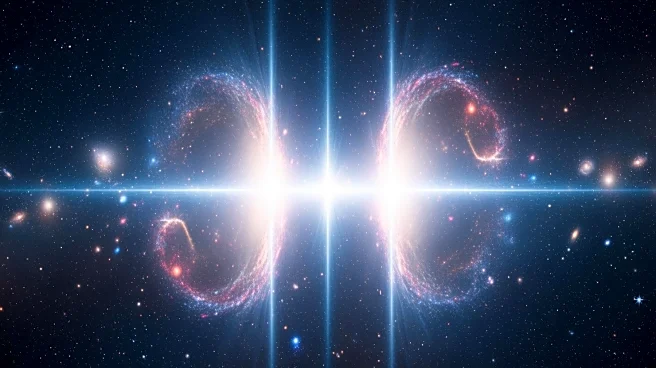
Astronomers using the MeerKAT telescope in South Africa have discovered a hydroxyl megamaser originating from a pair of colliding galaxies, HATLAS J142935.3–002836. This megamaser, amplified by gravitational lensing, is the brightest cosmic beacon ever
observed, having traveled 7.82 billion light-years to reach Earth. The discovery highlights the role of megamasers in understanding ancient galaxy formation and evolution. The phenomenon of gravitational lensing, first predicted by Einstein's theory of relativity, allows electromagnetic radiation from distant objects to be magnified, making it easier to study such cosmic events.
Why It's Important?
The discovery of this megamaser is significant for astronomers as it provides insights into the processes of galaxy formation and evolution. Megamasers serve as cosmic beacons, helping researchers understand how galaxies grow and die. The amplification of the signal through gravitational lensing offers a unique opportunity to study distant cosmic events that would otherwise be too faint to detect. This finding could lead to further discoveries of similar phenomena, enhancing our understanding of the universe's history and the dynamics of galaxy mergers.
What's Next?
Researchers plan to use the MeerKAT telescope to explore similar systems, aiming to discover more megamasers or gigamasers within gravitationally lensed objects. This could significantly increase the number of these rare space lasers available for study, providing more data on galaxy formation and evolution. The ongoing research may lead to new insights into the universe's structure and the role of gravitational lensing in observing distant cosmic events.